
 Written ByJamie
- Quick Checklist: 7 Steps To Compress Your Irons
- Understand Your Swing Arc (The Concept Most Miss)
- What Great Ball-Strikers Do With Their Wrists
- Trail Side Support (The Missing Piece)
- Setup and Grip for Solid Iron Contact
- Sequencing The Swing For Solid Iron Impact
- Ball Position By Club
- Ball Flight — What Actually Happens At Impact
Learning how to hit your irons consistently well is THE difference between fun golf and very not fun golf. (Assuming you aren’t terrible at everything else)
The better you hit your irons the longer they go, the higher they go, and the straighter they go.
In fact, I’d much rather have a great iron game than a great driver game. I figure I can always find a club that gets me off the tee.
So, what separates a flushed 7-iron from one that comes up 15 yards short.
Compression. And it’s simple to fix if you’ll observe a few fundamentals and put in a little work.
The fix isn’t some complex swing overhaul—it’s understanding one critical concept that 90% of golfers don’t grasp [1]: where to strike the ball in your swing arc.
Build a Reliable Iron Game (Start Here)
Mastering iron play comes down to contact, control, and repeatability.
These guides break the iron swing into clear, trainable components—so you can fix the root cause of poor contact instead of chasing swing tips.
Iron Setup & Fundamentals
- Iron Setup and Ball Position (Club-by-Club Guide)
- Iron Swing Fundamentals: Setup, Impact & Practice Plan
Contact & Low-Point Control
- Best Drills for Solid Iron Contact (Complete Training Program)
- Iron Distance Control: Turn Every Iron Into a Scoring Weapon
Shot Control & Trajectory
- How to Control Iron Trajectory (High, Standard & Low Shots)
- How to Hit a Fade With an Iron
- How to Hit a Draw With an Iron
- How To Hit Irons Higher
- How To Hit Irons Lower
Work through these in order, or jump directly to the area that matches your biggest miss. Each guide builds toward compressed contact, predictable distance, and tighter dispersion—the foundation of consistent iron play.
Quick Checklist: 7 Steps To Compress Your Irons
Before we get into the details, here’s what matters most:
1. Ball position slightly ahead of center for mid-irons, progressively forward for longer clubs.
2. Hands forward at address — shaft leaning slightly toward the target.
3. Weight 55-60% on your lead foot at address, shifting forward through impact.
4. Lead wrist flat to slightly bowed at impact — not cupped.
5. Body rotation supports the release — trail knee, hip, and shoulder turning through.
6. Descending strike — ball first, then divot.
7. Finish balanced over your lead side, chest facing the target.
Get these seven right and you’re most of the way there.
Understand Your Swing Arc (The Concept Most Miss)

Here’s what most instruction gets wrong: golfers think they need to hit the ball at the lowest point of their swing arc.
That’s a mistake. If you try to catch the ball at the exact bottom, you have zero margin for error. Miss by a quarter inch and you’re hitting it fat or thin.[1].
The fix: Position the ball so you catch it before the low point — while the club is still descending. This naturally compresses the ball, creates a slight divot after contact, and produces that solid strike you’re chasing.
A common teaching shortcut says the low point sits “directly under your lead shoulder.” That’s a rough starting point, but it oversimplifies things. Adam Young identifies at least four independent variables that determine low point — shoulder rotation timing, weight transfer, wrist conditions, and arc depth. Your sternum position plus wrist release timing are better predictors than shoulder position alone.
The practical takeaway: you want the ball positioned so the club reaches it while still traveling slightly downward. For most mid-irons, that means the ball sits roughly center to slightly forward of center in your stance. Don’t obsess over counting exact ball-widths — focus on where your divots start. If they start after the ball, your low point is in the right place.
The Draw Pattern You Need to Accept
Here’s the part that feels weird at first: When you strike the ball before the low point, your club path is heading to the right of your target 1-5 degrees ideally [1].
Most golfers panic when they feel this, thinking they’re going to hit the ball dead right. They’ll do one of three things:
- Come over the top to swing straight at the target.
- Flip their wrists through impact to square the face.
- Fall back onto their trail side to “help” the ball straight.
Instead, you need to close the clubface slightly (in relation to your path) at address and accept that the ball will start right and draw back. That’s how you build in margin for error and get consistent compression [1].
What Great Ball-Strikers Do With Their Wrists

compression) or hold the face open and push everything right. Both are symptoms of the same problem: the wrists aren’t doing their job through impact.
The fix: Your lead wrist needs to be flat to slightly bowed (flexed) at impact. When the lead wrist cups backward — extends — it opens the face and adds loft. That’s where those high, weak shots come from.
HackMotion analyzed over a million swings and found a clear relationship between lead wrist flexion at impact and strike quality. A flat or slightly bowed lead wrist keeps the face square to slightly closed, which delofts the club and produces compression.
When you set your hands forward at address, the clubface geometrically opens. To square it while keeping your hands ahead, you need to rotate your lead wrist and forearm downward through impact — not flip, rotate. HackMotion confirms this: many golfers try to achieve shaft lean by pushing their hands forward without adjusting wrist position, and the result is an open face.
There’s an alternative approach worth noting: a stronger grip can also help maintain a square face with shaft lean, without requiring as much active wrist rotation. Both solutions work — but you need at least one of them.
Practice drill: Hold a club out in front of you. Push your hands forward and watch the face open to the right. Now rotate your lead wrist downward until the face squares up. That’s the feeling you need through impact. Start with small chips and build from there.
Players often referenced for this bowed-wrist look include Dustin Johnson (extreme bow) and Jon Rahm (significant bow driven by a weak grip). Collin Morikawa uses a more moderate version with less bow and more forearm rotation. They’re not doing the exact same thing — but they’re all delivering the club with a flat-to-flexed lead wrist.
Trail Side Support (The Missing Piece)

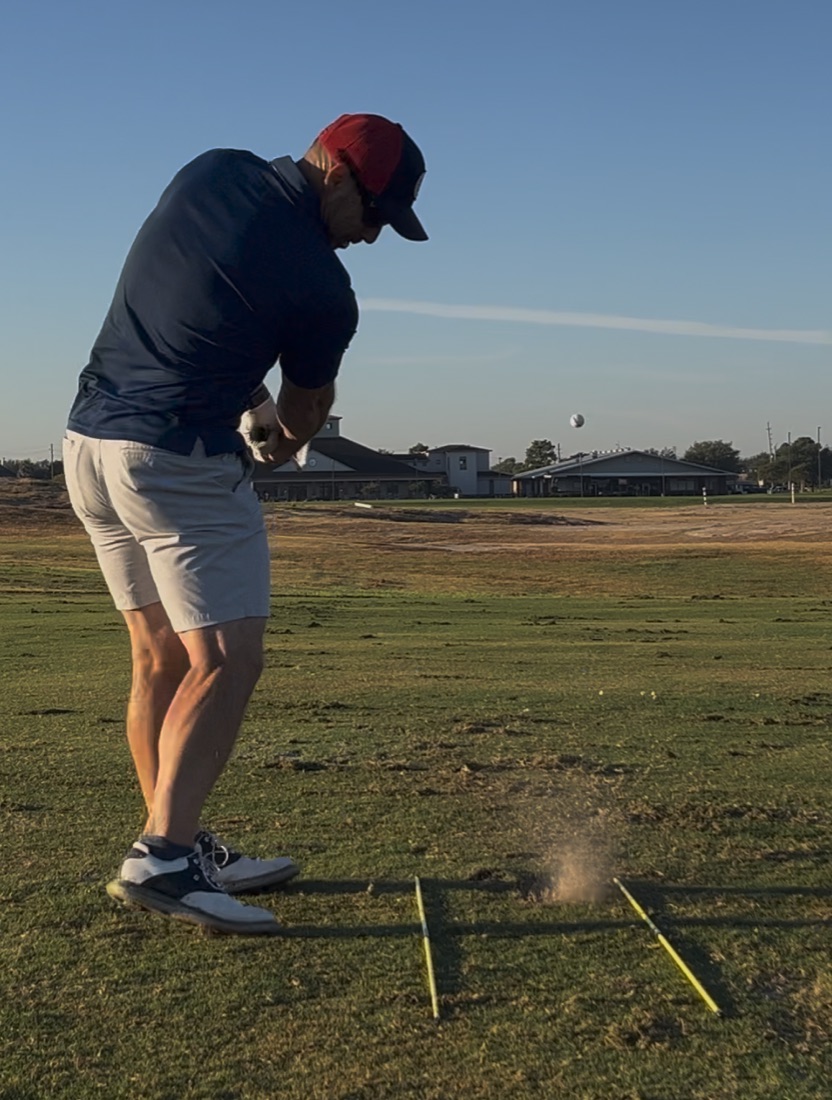
(This image shows me doing an excellent drill for trail side support)
If you just turn the wrist down without your body rotating to support it, you’ll hook everything. The lead arm can’t do this alone.
You need your trail side — right knee, hip, and shoulder for right-handers — to turn forward through impact. This keeps the face from closing too violently and generates power through rotation rather than just hand action.
Watch great ball-strikers at impact. Their trail side has an angle to it — knee bent and moving in, hips shifted forward, shoulder leaning into the shot. They’re supporting the release with their body, not just their hands.
The Golf Digest iron compression guide emphasizes straightening the trail arm through the hitting zone as part of this support — it’s what generates extension and power through the ball.
Without that trail side support, the clubface shuts too fast and you lose control. With it, you get a square face, compression, and speed.
Setup and Grip for Solid Iron Contact

Setup and grip is where compression gets made or lost. Golf Digest‘s guide puts it simply: all great iron players reduce loft at impact by getting their body forward over the ball. That starts at address.
Hands forward: Set your hands slightly ahead of the clubhead so the shaft leans gently toward the target. This promotes ball-first contact. Don’t exaggerate it — a small lean, not a lunge.
Grip pressure: 5-7 out of 10 at address. Tight enough to control the club, loose enough to feel the clubhead and let the wrists work properly. Pressure will naturally increase during the swing — that’s fine.
Spine tilt: Your spine should tilt slightly away from the target at address — not toward it. Your trail hand sits lower on the grip, which naturally drops the trail shoulder. For irons, this tilt is subtle (around 5 degrees). For driver, it’s more pronounced. This sets up a proper turn without a reverse pivot.
Neutral Grip Check
A neutral grip means the V’s formed by your thumbs and index fingers point between your chin and trail shoulder. If they point at your chin or lead shoulder, the grip is too weak and you’ll tend to leave the face open.
One caveat: if your lead arm is rotated too open at address (weak grip), you’ll want to roll it open through impact, which makes the face hard to square. A slightly stronger grip can help here — it lets you maintain a square face through impact without having to rely on aggressive wrist rotation.
Stance Width And Posture By Club
Stance and posture change with club length. Golf Monthly emphasizes maintaining spine angle as the key to centered strikes.
Wedges and short irons: Narrow stance (inside shoulder width), slightly more upright spine. Ball position center of stance.
Mid-irons: Shoulder-width stance, slight forward lean. Ball position center to slightly forward of center.
Long irons: Shoulder-width or just wider, ball position one ball-width forward of center.Driver and woods: Wider stance, ball forward near lead heel. You’re sweeping it, not hitting down.
Sequencing The Swing For Solid Iron Impact
This is where most players go wrong. They have decent setup positions but the swing sequence falls apart.
Takeaway: Keep the clubhead low and slow for the first foot or so. This sets your tempo and prevents early hand action.
Mid-backswing: Maintain extension to build width while your body initiates the turn. Golf Monthly stresses staying centered — rotating around your spine, not swaying.
Transition: Shift pressure to your lead foot while maintaining wrist hinge. Don’t cast the club early. That stored hinge is your compression source.
Downswing sequence: Hips first, then torso, then arms, then hands, then clubhead. This kinematic sequence promotes a descending blow and keeps the club on plane. If your hands fire first, you’re flipping and adding loft.
Impact: Get your pelvis over your lead heel. Your lead arm rotates down. Your trail side supports with knee, hip, and shoulder moving forward. Straighten your trail arm through the hitting zone. Finish balanced with your chest facing the target.
Weight Transfer During The Swing
Weight transfer follows a simple pattern: load the trail foot on the backswing, then shift progressively to the lead foot through impact. Swing Catalyst data shows tour pros averaging roughly 70-85% trail-foot pressure at the top of the backswing, then finishing with 85-95% on the lead foot.
You should feel pressure on the inside of your back foot at the top, then a rolling, stepping sensation toward your lead heel through the ball.
The key: that weight shift has to happen while you’re maintaining your spine angle and rotating, not sliding. If you sway off the ball or hang back, you lose low point control.
Angle Of Attack — Hit Down On It (The Right Way)
Irons require a slightly descending angle of attack — ball first, then divot. This compresses the ball, creates a lower trajectory, and gives you spin for control.
Signs you’re too steep: Fat shots, deep divots pointing left, loss of distance.
Signs you’re too shallow: Thin strikes, no divot, ballooning ball flight.
The fix isn’t complicated: position the ball correctly and get your weight forward. That preset encourages a downstrike without having to manipulate anything during the swing.
Ball Position By Club
Ball position controls everything about your strike pattern. Here’s the practical breakdown:
Driver: Inside lead heel (widest stance, catch it ascending).
Fairway woods/hybrids: Just forward of center.
Long irons (3-5): One ball-width forward of center.
Mid-irons (6-7): Center to slightly forward of center.
Short irons (8-9): Center of stance.
Wedges: Center of stance.
The pattern: shorter clubs require more descending strikes, so the ball sits at or near center. Longer clubs need shallower strikes, so the ball moves progressively forward. This aligns with how Nicklaus taught it — he played all irons from roughly the same spot relative to his lead side and adjusted stance width, which effectively moved the ball back relative to center for shorter clubs.
Don’t overthink this. The divot test tells you everything: if your divots consistently start after the ball, your low point is ahead of where it needs to be. If they start behind the ball or you’re hitting fat, you likely need the ball slightly further back or your weight further forward.
Ball Flight — What Actually Happens At Impact
This matters because bad information here leads to bad compensations. Here’s what TrackMan has confirmed with millions of data points:
The ball starts primarily where the face points at impact — not where the path is going. For irons, the face controls roughly 75% of the starting direction. The path determines the curve.
So if you want a draw (starts right, curves left for a right-hander), the face needs to be slightly open to the target but closed relative to the path. If you close the face to the target at address and swing in-to-out, the ball will start left and draw further left — a pull-draw that misses everything.
This is one of the most commonly confused concepts in golf instruction. The old model said the ball started on the path line. Launch monitors proved otherwise. Get this right and a lot of your shot-shaping confusion goes away.
For most recreational golfers, the best approach is to aim for a relatively neutral path (within ±2 degrees) and a square face. Whether that produces a slight draw or slight fade is less important than producing consistent, compressed contact.
Drills That Build Compression
These are the drills that address the actual contact issues.
Tee drill. Place a tee in the ground an inch in front of your ball. Your goal is to clip the tee after striking the ball. This trains a descending angle of attack and forward low point. If you’re catching the tee before the ball, your low point is too far back. 20-30 reps per session.
Brush the grass drill. Start with your pitching wedge. Swing back and forth to hip height with a tic-toc tempo, brushing the grass at the same spot. Gradually build to a full swing, keeping that rhythm. Focus on brushing the ground slightly forward of center on the downswing. Five minutes per session.
Tempo drill. John Novosel’s research found that virtually all elite golfers share a 3:1 tempo ratio — three beats for the backswing, one beat for the downswing. Practice without a ball first: take 10 swings counting “one-two-three” on the backswing and “four” on the down. Then hit 10 balls maintaining that tempo. Five minutes per session.
Anti-sway drill. Place an alignment stick vertically beside your trail hip. During the backswing, your hip should rotate but not push past the stick. This prevents lateral sway and stabilizes your low point. If you’re pushing the stick, you’re swaying instead of turning.
Impact bag drill. Set up with a mid-iron and make slow swings into an impact bag or stack of old towels. Focus on feeling your hands ahead of the clubhead at contact. Start with chip-length swings and build to half swings. The bag gives instant feedback — if you’re flipping, you’ll feel it.
Punch shot drill. Hit 20-30 punch shots with a 7-iron.
Ball center of stance, three-quarter swing, hands ahead. Focus on keeping the ball flight low and controlled. This is the single best drill for grooving a forward-leaning shaft at impact.
Practice Plans & Progress Tracking
Random range sessions don’t improve your game. You need structure and measurable targets.
I’ve worked with Chris Westerdahl Golf to create a practice system that tracks two things: low point control (hitting the ball before the ground) and strike quality (center contact). We call it the Contact Combine.
The Contact Combine Assessment
Run these two tests at the start and end of each practice session:
Assessment 1: Ball-First Contact
- Use foot spray to draw a line on the grass where the ball sits
- Hit 10 balls trying to make your divot start ahead of that line (target side)
- Record how many times you achieve ball-first contact
- Switch to a different iron each session
Assessment 2: Sweet Spot Contact
- Apply foot spray or impact tape to your clubface
- Hit 10 balls aiming for center contact
- Count and record how many hit the sweet spot
Track your results: date, time, number of successful ball-first contacts, number of center strikes, and any notes on what you felt or adjusted.
Practice Drills That Work
We yanked these drills straight from our “Iron Game Secrets Cheat Sheet.” Enjoy! (Courtesy of Chris Westerdahl Golf)
Brush the Grass Drill (5 minutes per session)
This trains consistent ground contact and tempo.
Start with your pitching wedge. Swing back and forth to hip height with a “tic-toc” tempo, brushing the grass at the same spot on both sides. Gradually build to a full swing, keeping that same rhythm. As your swing gets longer, focus on striking the ground slightly forward of center on the downswing—that’s your low point moving ahead like it should.
Tempo Drill (5 minutes per session)
Ideal tempo for most players is 3:1—three beats for the backswing, one beat for the downswing [1].
Practice without a ball first: Take 10 swings with a 7-iron using a metronome or counting “swing (1) – set (2) – through (3)” to lock in the rhythm. Then hit 10 balls maintaining that same tempo and observe strike quality.
Sway Drill (20 minutes, 2-3 times per week)
Minimizes lateral motion to stabilize your low point [1].
Place an alignment stick vertically in the ground directly behind your tailbone. During the backswing, stay in contact with the stick. During the downswing, move toward the target so you finish slightly ahead of the stick.
2×4 Takeaway Drill (20 minutes, 3 times per week)
Encourages a connected takeaway with arms and chest working together.
Place a 12-inch 2×4 (or alignment stick) one clubhead length behind the ball at address. During your takeaway, push the 2×4 straight back using both arms and chest in unison. This syncs up your body and arms through the entire swing.
Recommended Practice Schedule (For rapid improvement)
Five days per week, 50 minutes per session:
- Contact Combine assessment: 10 minutes (start of session)
- Contact Combine assessment: 10 minutes (start of session)
- Brush the Grass: 5 minutes
- Tempo Drill: 5 minutes
- Sway Drill: 20 minutes (Days 1-2)
- Takeaway Drill: 20 minutes (Days 3-5)
- Contact Combine assessment: 10 minutes (end of session)
Day 1 | Day 2 | Day 3 | Day 4 | Day 5 | |
|---|---|---|---|---|---|
Contact Combine | 10 min | 10 min | 10 min | 10 min | 10 min |
Brush the Grass | 5 min | 5 min | 5 min | 5 min | 5 min |
Tempo Drill | 5 min | 5 min | 5 min | 5 min | 5 min |
Sway Drill | — | 20 min | — | 20 min | — |
Takeaway Drill | 20 min | — | 20 min | — | 20 min |
Contact Combine | 10 min | 10 min | 10 min | 10 min | 10 min |
Total | 50 min | 50 min | 50 min | 50 min | 50 min |
The power is in the tracking. You’ll see exactly how many ball-first contacts and center strikes you’re producing each session. When the numbers improve, you know the work is paying off. When they plateau or drop, you know what needs more attention.
How Do You Track Progress and Transfer Practice to Course?
Range improvement means nothing if it doesn’t show up on the course.
Objective metrics to log: Ball speed, carry distance, left/right dispersion, clubhead speed, divot depth and length, contact quality (center vs. off-center hits).
Simple practice log template:
- Date
- Club
- Drill name
- Sets × reps
- Tempo target (3:1 backswing to downswing ratio works for most players)
- Measured result (carry distance, dispersion, strike location)
- Feel notes (what worked, what didn’t)
- Monthly review to set progressive goals 6543
Video comparisons: Capture impact and follow-through from the same camera angle each session. Time-stamp your videos. Annotate slow-motion frames to check:
- Pelvis position at impact (should be over lead heel)
- Lead arm rotation (turning down, not flipping)
- Trail side support (knee, hip, shoulder moving forward)
- Shaft lean at impact (hands ahead of ball)
Course transfer strategy: Map your range carry distances to specific holes and yardages on your home course. Create a club-selection chart. Practice those exact yardages with the same pre-shot routine you’ll use on the course.
Pressure drills: Timed targets, penalty-based games (lose a ball for missing the target), simulated hole play with scorekeeping. Measure whether your range gains hold up under stress. If they don’t, you need more pressure practice.
Common Mistakes and Quick Fixes
Hooking it too much: You’re turning the face down but not supporting it with your trail side. Get that right knee, hip, and shoulder moving forward through impact [2].
Still pushing it right: You’re not rotating your lead arm down through impact. You’re still in the old throw/block pattern. Practice the turn-down release with small chips first.
Fat shots: Ball position is too far forward, or you’re hanging back on your trail side. Check that the ball is 2-3 balls behind your low point and your pelvis is over your lead heel.
Thin shots: Either your ball position is too far back, or you’re standing up through impact. Maintain your spine angle [4] and check your posture at setup.
Inconsistent contact: Either ball position is too far back, or you’re standing up through impact. Maintain your spine angle through the strike — Golf Monthly emphasizes this as the key to centered contact.
Iron Play FAQs
How does turf interaction affect iron spin?
Clean, slightly descending contact compresses the ball so the grooves bite and generate backspin. Thin or buried strikes reduce compression and spin.
Signs of good turf interaction: Shallow divot starting just after the ball, crisp sound at impact, minimal turf residue on the face.
Should I use the same ball position for all irons?
No. Ball position must be 2-3 balls behind your low point for every club [1], but because your stance width changes, the ball’s position relative to your feet changes too.
Progressive positioning:
Driver: Inside lead heel (widest stance, ball forward to catch it ascending)
Hybrid: One to two balls forward of center.
Long iron (3-4): as hybrid.
Mid-iron (5-7): One to two balls forward of center.
Lob to 9-iron: Center of stance
Final Thoughts on How to hit your Irons
Hitting your irons better isn’t complicated. It’s about compression and direction.
To recap, here’s how we get compression, thus, better ball striking.
The secret is striking the ball with a descending blow.
Position the ball 2-3 balls behind the low point of your swing—which sits directly under your lead shoulder. This catches the ball while the club is still descending and heading slightly right of your target
- Position the ball behind your lead shoulder/low point (2-3 balls) so you catch it with a descending (powerful) blow.
- Close the face slightly to account for the in to out swing direction. The ball starts right (for right handers) and gently curves back on target.
- Set your lead hip over your lead hill at address and keep it there through impact. This promotes the in to out swing path and keeps our low point ahead of the ball.
- Turn your lead hand and arm down through impact. Insurance against an open clubface.
- Support it with your trail side moving forward. (trail side bend)Think turning through the strike instead of casting.
- Accept your beautiful new draw pattern.
Additionally, the Contact Combine drills give you a measurable way to track whether you’re actually doing it. Ten balls, twice per session. Count your ball-first contacts and center strikes. The numbers don’t lie.
Most players spend years trying to “fix their swing” when the real issue is they don’t understand where in the arc to strike the ball. Now you do.
Thanks for checking out our guide on how to hit your irons better. Let us know how it worked for you.
Sources
Danny Maude — “Why 90% of Golfers Can’t Strike Their Irons & Hybrids”
Danny Maude — “The ONLY Way To Strike Your Irons Every Time”
Golf Digest — How to Hit Crispy Iron Shots (Joe Plecker)
Golf Monthly — Secret to a Centred Strike With Irons
HackMotion — Insights from 1M+ Swings
HackMotion — Shaft Lean at Impact
Adam Young Golf — Low Point Control
Andrew Rice Golf — Forward Shaft Lean
USGolfTV / Swing Catalyst — Weight Distribution in the Golf Swing