
 Written ByJamie
- What Is Solid Iron Contact and Why Does It Matter?
- What Is the Setup Checklist for Consistent Iron Contact?
- How Do You Sequence the Backswing and Transition to Impact?
- How Do You Compress the Ball and Diagnose Contact Faults?
- How Should You Structure Progressive Drills and Practice?
- FAQs
- Final Thoughts on Iron Swing Fundamentals
- Sources
Like most handicap golfers, I often suffer from poor iron swing fundamentals and the frustration that inevitably follows.
Inconsistent ball-striking. Fat shots. Thin shots. Pushes. Pulls. Hooking (happens to me often).
It doesn’t have to be this way.
Master the basics — grip, setup, ball position, weight transfer, and impact — and you’ll compress the ball, start it on your line, launch it on the proper trajectory, hit more greens, and shoot better scores.
If you’re looking for the step-by-step framework for building a reliable iron swing, start with our complete guide on how to hit your irons.
This article focuses on refining those fundamentals with measurable benchmarks and diagnostics.
What Is Solid Iron Contact and Why Does It Matter?
Solid iron contact means compressing the ball by hitting it in the center of the clubface — or very close to it. (Even my best strikes are a smidge towards the toe.)
This maximizes smash factor: ball speed divided by swing speed. Think of it as getting the most yardage out of whatever swing speed you generate.
The difference between a 7-iron that carries 155 yards every time versus 145–165 yards? The quality of your contact. (My personal average carry with my 34° 7-iron is 165 yards and has been for a couple decades — unless I’m hitting it particularly well and it’s mid-summer.)
Reading divots: A shallow divot beginning just after the ball, with the deepest point about 4 inches past where the ball sat, pointing down your target line.
That confirms a descending strike and ball-first contact. No divot or a divot starting behind the ball? You’re not hitting down on it.
Smash factor targets: For irons, aim for 1.35–1.40+. Pair with impact tape and divot shape to validate improvements during practice.
What Is the Setup Checklist for Consistent Iron Contact?
Setup creates the conditions for repeatable contact. Get this wrong and you’re fighting your swing from address.
Stance width: Feet about shoulder-width for mid-irons. Slightly narrower for wedges, a bit wider for long irons.
Ball position should match club length and promote a descending strike. For a full club-by-club breakdown, see our iron setup and ball position guide.
Shaft lean and hand position: Position hands slightly ahead of the ball at address to create mild forward shaft lean.
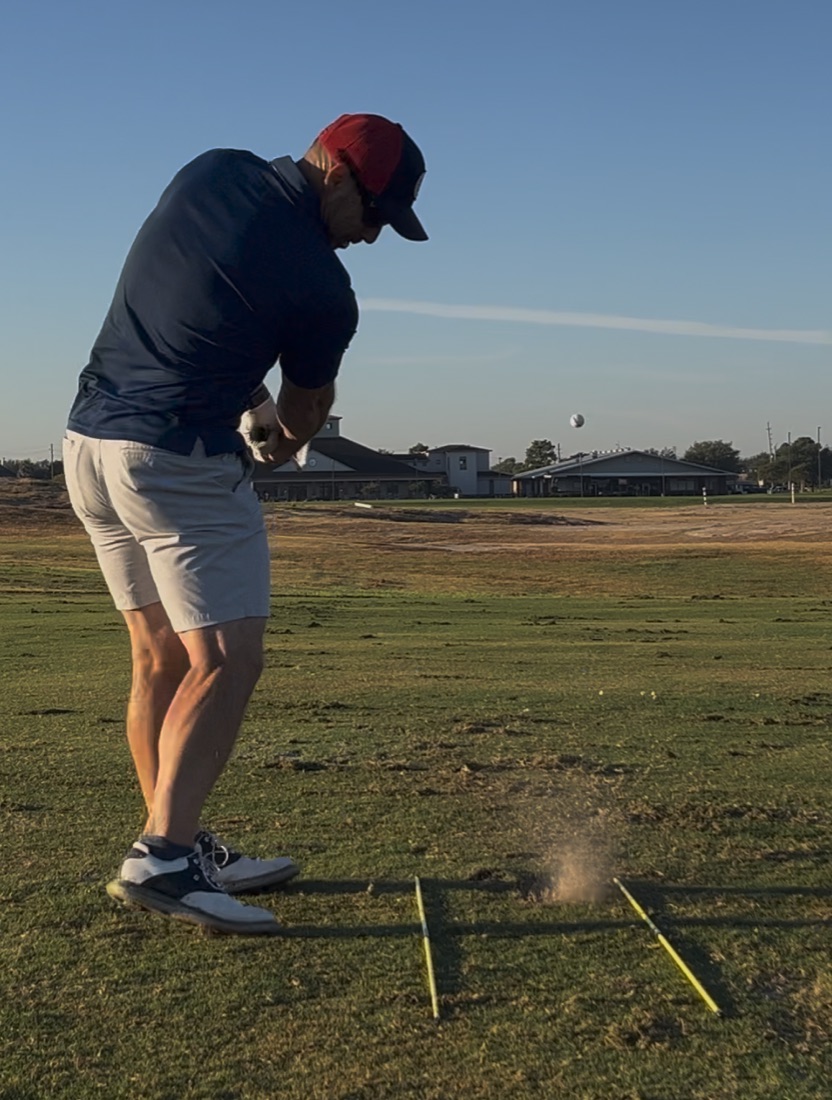
This de-lofts the clubface and promotes a downward attack. Avoid excessive lean that blocks release. (Don’t copy my shaft lean at address. I’ve got excessive lean from a drill I’ve been doing for years. I’m working on neutralizing it.)
Posture and weight distribution: Hinge from hips with a flat back, soft knees, shoulders level, balance over the balls of your feet.
Rick Shiels teaches starting with 60% weight on the lead foot with your sternum slightly left of center for mid-irons.
His logic: wherever the bottom of your swing hits the ground matches up to the middle of your body. If that center is too far back, you’ll hit the ground behind the ball.
Get the zip on your shirt directly over the ball at address, and the low point takes care of itself.
Quick setup validation: Align feet, hips, shoulders parallel to target. Use the tee-behind-ball drill (place a tee 2–3 inches behind the ball and swing without hitting it) to confirm your low point is ahead of the ball.
How Do You Sequence the Backswing and Transition to Impact?
Sequencing determines whether you store and release energy efficiently or leak power through poor timing.
Let the club swing freely first. Danny Maude’s swing basics lesson (inspired by Pete Cowan) starts here: most golfers who lose their ball-striking try to regain control by adding tension.
That’s backwards. The clubhead needs to swing freely — feel its weight, let it fall to the ground, then gradually add speed like cracking a whip. You hit a golf ball with a clubhead, not with tension.
Wind up, don’t turn around. Once the club is swinging freely, your body supports and controls that swing. .
Maude’s key distinction: the body winds up like a corkscrew — not a baseball-style rotation. There’s an angle to it. If you turn flat and level, you move off the ball and have to make compensations on the way down.
If you wind up with a slight spiral, you stay centered and the downswing happens almost for free — like releasing a wound-up spring.
His Pete Cowan-inspired drill: push your palms toward the ground, then rotate them to face the ceiling. Your body winds up with tension in your legs, torso, and shoulders. Let that tension unwind and it fires back down.
Lag through transition: Clay Ballard’s approach reinforces keeping the takeaway wide and low, then increasing wrist set as you transition to the downswing.
Maximum lag angle occurs for a split second before impact — setting the wrists early in the takeaway kills it.
Lower body leads: Initiate the downswing with a pressure shift from trail to lead leg so hips start before hands. This allows the club to shallow into the slot.
How Do You Compress the Ball and Diagnose Contact Faults?
Assuming you understand low-point control and forward shaft lean from the core iron guide, compression becomes a measurable outcome — not a theory.
The compression goal: Create a consistent low point just ahead of the ball using forward shaft lean, a descending strike, and proper weight distribution on your lead foot at address.
Where you hit the face matters. Chuck Quinton of Rotary Swing explains that the ideal iron strike lands slightly below the center of gravity on the clubface — not above it.
Most amateurs hit high on the face, which adds loft and kills penetration. Good ball strikers have a wear spot that looks a groove or two low.
When the ball strikes below the CG, the face naturally de-lofts through impact. That’s how you get flat, penetrating iron shots without manipulating your hands.
Get your center of mass forward. The other key Quinton teaches: shift your hips forward so your lead leg moves past its address position at impact.
This tilts the spine back slightly, creating leverage against your arms and the shaft — which keeps the hands driving forward through the strike without flipping.
He shows Tiger Woods doing exactly this on a wedge — Tiger’s lead leg at impact is well outside where it started at address.
Tee-behind-ball drill: Place a tee 2–3 inches behind the ball and make practice swings without hitting it. If you can’t miss the tee, your low point is too far back.
Diagnosing Fat Shots
Heavy thud, loss of distance, turf contact before the ball. Common causes: sway to trail side, reverse pivot (weight stays back), early release. Fix: set up with more forward weight, feel pressure in lead foot through impact, practice half-swings focusing on ball-first contact.
Diagnosing Thin Shots
Low launch, reduced spin, poor stopping power. Causes: standing up through impact, losing posture, arms extending too early. Fix: maintain spine angle through impact, focus on rotating through the shot rather than lifting.
Diagnosing Heel/Toe Strikes
Inconsistent distance, gear effect curves. Causes: incorrect distance from ball at setup, loss of posture, poor sequencing. Fix: use impact tape to identify the pattern, adjust distance at setup, practice half-swings focused on center contact.
How Should You Structure Progressive Drills and Practice?
Random ball-beating doesn’t build skills. Structured practice with measurement does.
Warm-up (8–12 min): Thoracic rotation, hip mobility, and 10–15 slow-motion swings with tempo focus to expose baseline mechanics.
Short diagnostic block (10–15 swings): Use a launch monitor to record impact location, clubface angle, and delivery path. If no launch monitor, use impact tape on the clubface to identify strike patterns.
Progressive drill sequence:
Phase 1 — Half-swings (40–60 reps): Focus on club path and face angle. Checkpoint: club pointing at target line, face square to path. Use impact tape to verify center contact.
Phase 2 — Punch shots (30–40 reps): Three-quarter swings with ball-first contact. Checkpoint: divot starts after ball, center-face strikes. Track percentage of center hits — target 70%+.
Phase 3 — Speed ladder (20–30 reps): Three slow swings, one full-speed swing. Checkpoint: maintain center contact at all speeds.
What to track: Center-impact percentage, carry variance, attack angle, and clubhead speed. Work in sets of 8–12 swings per drill. Log metrics and review trends weekly.
Transfer to the course: Play 6 full swings from varied lies on-course or on a simulator. Compare your range numbers to on-course results. The gap between the two is where your real improvement lives.
If you’re looking for the step-by-step framework for building a reliable iron swing, start with our complete guide on hitting your irons consistently.
FAQs
How should ball position change for different irons?
Lob to 9-iron: Center of stance.
8 to 6-iron: About 1 ball forward of center.
Long irons : 2-3 balls forward of center. You’ll have to do some testing.
How does turf type affect divot and contact?
Firm, tight lies: Produce shallow, shorter divots. Require slightly forward ball position and shallower attack angle to avoid thin shots. Focus on sweeping through impact rather than digging.
Soft or wet turf: Creates deeper, longer divots. Recommend more downward strike with lower hands and firmer grip to compress ball. Expect club to release less through turf.
Fluffy rough: Requires steeper clubface descent and shorter swing to prevent grass pickup and maintain contact. Ball may come out with less spin.
Quick setup checks: Center weight slightly left of center at address. Keep hands ahead of ball at impact. Commit to decisive tempo to control divot shape across varying turf conditions.
Final Thoughts on Iron Swing Fundamentals
Iron swing fundamentals aren’t complicated—they’re just overlooked. Grip, ball position, weight distribution, sequencing, and impact mechanics. Master these and you’ll compress the ball, create predictable divots, and hit approach shots that hold greens.
The difference between a player who strikes it pure and one who doesn’t? Attention to setup and measurement of results. You can’t improve what you don’t track.
Start with the setup checklist. Record baseline launch-monitor numbers (or just track divot patterns and carry distance if you don’t have tech). Pick one drill from this guide. Test it for two weeks. Record the change. Adjust.
Most golfers skip this part. They hit balls without purpose, hoping repetition creates consistency. It doesn’t. Structured practice with measurable targets does.
If you’re serious about better iron play, invest in a launch monitor or join a facility that has one. The feedback loop shortens learning time by months. You’ll see exactly what your swing produces—not what you think it produces.
Use the diagnostic checklists in this guide when you miss shots. Fat? Check weight distribution and low-point control. Thin? Check posture and early extension. Heel strikes? Check distance from ball and sequencing.
The drills work. The checkpoints are proven. The metrics don’t lie.
Thanks for checking out our guide to iron swing fundamentals.
Sources
- Clay Ballard & Robin Rosado (Top Speed Golf) – “How to Hit Irons For Beginners” – Comprehensive coverage of grip fundamentals, swing plane, and the speed trap training aid for inside-out path development
- Danny Maude – “GOLF SWING BASICS – How to Strike Your Irons” – Trail arm mechanics, rotation timing, and split-hand grip drills for consistent compression
- Rick Shiels Golf – “Stop Ignoring Golf Swing Basics if You Want Consistent Irons” – Weight distribution (60/40 split), balance fundamentals, and flow versus rigidity in the swing
- Scratch Golf Academy – “Iron Swing Basics | How to Swing Irons with Confidence” – Wrist action timing and swing plane control for accuracy and consistency
- Foresight Sports – “The Perfect Iron Swing” – Full finish position, body rotation to target, and launch monitor metrics for validation
- Rotary Swing – “Iron Golf Swing Tips | 2 Keys to Penetrating Iron Shots” – De-lofting clubface at impact and creating low, flat stinger ball flights