
 Written ByJamie
- What Is a Fade? How Do Face and Path Create It?
- When Should You Use a Fade?
- How Should You Set Up for a Controlled Fade?
- How Do You Swing to Produce the Fade?
- What Drills Build a Reliable Fade?
- How Should You Adjust for Different Irons?
- How Do You Use a Fade in Course Strategy?
- How Should You Measure Progress?
Learning how to hit a fade with irons and otherwise shape your shots at will is one of those skills that separates good players from elite players.
Not because it’s complicated—it’s not. But because many players are doing it completely wrong.
A real fade—the kind tour players use—isn’t about cutting across the ball.
It’s about controlling two things: your clubface angle relative to your swing path, and your body alignment relative to your target.
Get those right and you’ve got a high-spinning, controllable shot that holds greens and works around trouble. Miss them and you’re fighting a weak slice all day.
One thing to note: some may think of the fade as a “weaker” shot. Not so. That said, if compressing the ball with the irons is an issue, we’ve got you covered. Check out our guide to hitting and compressing your irons.
What Is a Fade? How Do Face and Path Create It?
For right handers: A fade is a controlled left-to-right ball flight.
The ball starts toward where your clubface is aimed, then curves right.
Just reverse this for left handers.
The ball’s initial direction is determined by your clubface angle at impact, not your swing path. The curve comes from the relationship between clubface and path.
For a fade, your clubface needs to be open relative to your swing path. Not open to your target—open to your path.
Example: Swinging 5° left of target with clubface 3° left of target = face is 2° open to path. Ball starts left (clubface aim), curves right (face open to path). That’s a fade.
A controlled fade shows 2-5° face-to-path difference [1]. More than that and you’re slicing.
A fade produces slightly higher spin than a draw for better stopping power but a slight loss of distance, maybe 5-10 yards less.
When Should You Use a Fade?
Use a fade when you need:
- Extra spin to check the ball on firm greens.
- Shape to work around left-side trouble.
- Control in left-to-right wind.
- You need to hit the ball higher.
How Should You Set Up for a Controlled Fade?
Ball position: Forward of center. The exact amount varies by club—more forward for longer irons, less forward for short irons.
Stance: Shoulder-width or slightly narrower.
Alignment: Set your feet, hips, and shoulders slightly left of your target [2] (for right-handers). Your clubface aims at the target or slightly left.
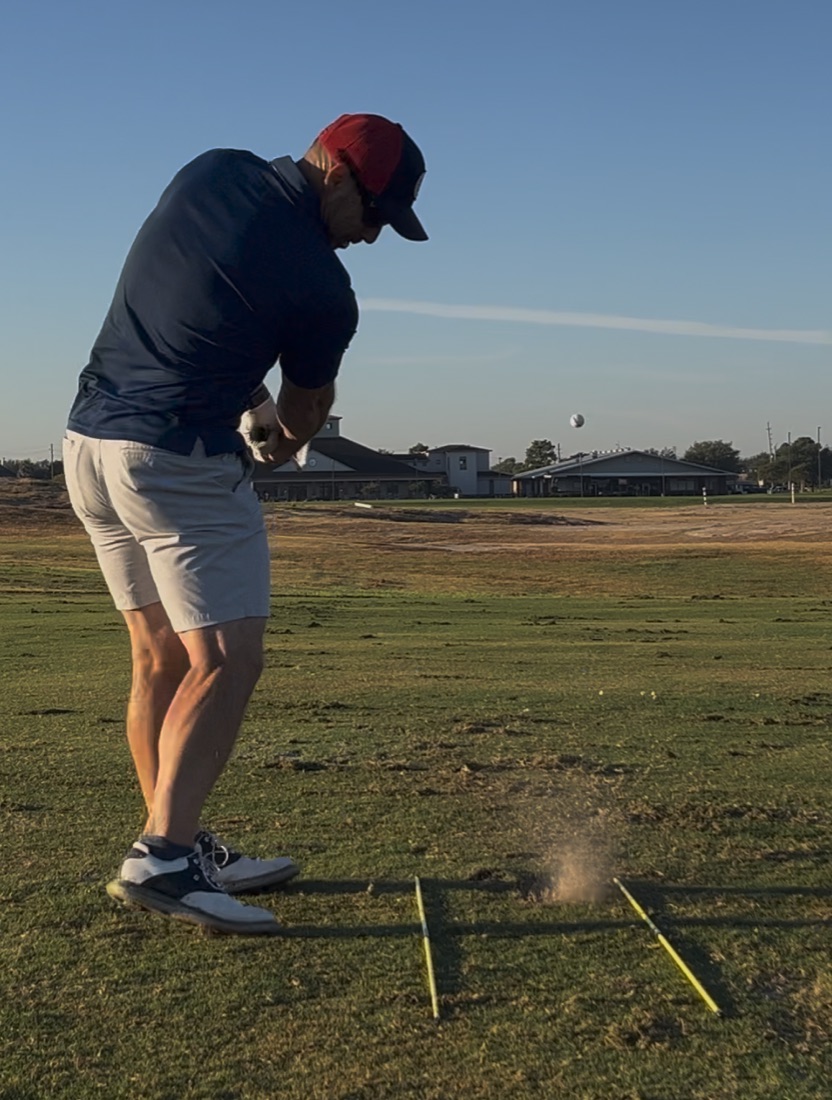
Use alignment rods—one down your toe line, one perpendicular to target. Toe-line rod should point left of target rod.
Grip: Neutral to strong [1]. Strong grips like Lee Trevino, David Duval, and Paul Azinger used make it easier to support the club and keep the face open.
Pre-shot routine:
- Pick final target
- Pick start line left of that
- Aim clubface at target
- Align body to start line
- Commit
How Do You Swing to Produce the Fade?
Assuming you’ve set up correctly for our controlled fade, swing along your body line.
Face control: Keep the heel ahead of the toe through impact [1]. Your trail wrist needs to be bent at impact—if it straightens, flips or gets thrown at the ball, the face closes.
Body movement: Strong lower body motion is critical [1]—if you’re frozen with your hips, your hands get too active. The club’s heavy at high speed—if you’re going to keep that trail wrist bent, you’ve got to engage and spring up into your lead hip.
The Takeaway Adjustment for Shot-Shaping
When you’re really trying to work the ball, there’s a component of feeling that in your takeaway [3]. It’s sometimes unrealistic to take the club back to where your stock draw is and just not have the clubface in your hands rotated a little bit better to promote the cut you’re trying to hit.
Think of it like a ping-pong paddle [3]. If you’re holding a paddle and someone said “hit a cut forehand,” you wouldn’t start with the paddle shut. You’d rotate it slightly open in your hand to set up the cut. Same with the golf club.
The feel: As you take the club back, rotate the clubface slightly open in your hands—just enough that when you look at it halfway back, it’s pointing more at the sky instead of shut down. This sets you up to hold that open face through impact without having to manipulate it coming down.
Don’t overdo it. Just a subtle rotation. You’re not trying to lay it wide open—you’re just setting yourself up for success.
What Drills Build a Reliable Fade?
Drill 1: Alignment Rod Setup
Set up alignment rods with one pointing at your target and another showing where you’re aimed [1]. The rod showing your body line should be aimed slightly open (left for right-handers). This helps you feel the correct setup geometry.
Drill 2: Flat-to-Bent Wrist
Take a 7-iron to just past your trail foot on backswing—the clubface should be looking more or less at the ball and your trail wrist should be flat [1]. As you come into impact with help from your lower body, that’s when the wrist bends. That’s when the heel stays ahead of the toe.
Practice on small swings—if you can hit little shots going from flat wrist to bent wrist, you are on your way to being a controlled fader [1].
Key practice point: You have to play around with that clubface through impact [2]. Experiment—overdo it, underdo it, do it on a small scale. Get a big fade, dial it back. That’s how you build skill and learn to control how much the ball moves.
Drill 3: Half Swings First
Start with half swings [2]. Practice the feeling and once you get good at it, ramp it up to full swings.
How Should You Adjust for Different Irons?
The fundamentals stay the same, but ball position adjusts by club length.
Don’t expect massive curvature with today’s equipment [1]—even players on tour that fade it, with maybe the exception of Bubba Watson, it doesn’t move much. It’s more of a slight movement and more or less where their miss is guaranteed to be on the fade side, not the draw side.
How Do You Use a Fade in Course Strategy?
When to choose it:
- Doglegs favoring left-to-right.
- Elevated greens needing check.
- Front pins requiring higher shots and more spin.
- Left-side trouble.
- Firm conditions where draw would release too much.
- etc.
Pre-shot execution:
- Pick landing spot
- Pick start line left of that
- Aim clubface at final target or slightly left [2]
- Align body to start line
- Visualize curve
- Commit
How Should You Measure Progress?
Use video to check:
- Face-to-path at impact
- Clubface angle through zone
- Finish position [2]—handle and arms tracking around you, not thrown out away
- Ball flight (start vs. finish)
A few degrees of difference is very easy to happen [2] by the time the club moves seven, eight, nine feet and comes all the way back. One tick of the second hand on a clock is six degrees—six degrees off with the clubface is a catastrophic difference.
That’s why you’ve got to practice to develop the skill [2]—there’s no magic formula.
Fade With Irons FAQs
Is it better to hit a draw or fade?
Neither. Depends on the shot, course, and your skillset.
Draw: more distance, better downwind, useful for right-to-left holes.
Fade: tighter control, softer landing, easier to execute for most players.
Pick the shot that fits the hole and that you can execute with confidence. Practice both.
Why am I hitting weak fades?
Three main causes:
1. Clubface too open at impact: Check with video. If face is way open, you’re slicing. Work on the flat-to-bent wrist drill.
2. Low clubhead speed: Not enough compression. Add tempo drills and weight-transfer work [1].
3. Frozen lower body: If your hips aren’t moving, your hands get too active [1]. Engage your lower body through impact.
Where should I aim when shaping a fade?
You’re going to set your body on a direction left of target [2]. The clubface has to be open relative to that at impact, but it cannot be as much open as the target line.
Steps:
Pick final target
Pick intermediate target left of that
Aim clubface at final target or slightly left
Aim feet, hips, shoulders at intermediate target
Swing along body line
The ball will start more or less where the clubface is aimed at impact [2], not so much where you’re swinging.
Should I change my grip to hit a fade?
A lot of people think if they weaken their grip it helps fade the ball [1], and in a certain sense it does—it’s harder to close the clubface. But if you’re going to be a strong, consistent fader, go neutral to even slightly strong.
From a neutral position, it’s a lot easier to support the club and keep the face open [1] as you go through impact.
Final Thoughts on Fading Your Irons
A controlled fade with your irons isn’t complicated, but it does require you to understand the relationship between clubface and path.
The setup gets you 80% there: body aimed left of target, clubface aimed at target, ball position forward. That geometry creates the out-to-in path you need.
The other 20% is feel. Keep your trail wrist bent through impact. Finish with your arms closer to your body, not thrown out . The heel stays ahead of the toe.
Don’t assume your setup guarantees the fade You’ve got to feel it at impact. Practice small swings first—experiment with how much you open the face, how much you hold off the release. Build the skill through reps, not theory.
Most importantly: the fade isn’t about swinging across the ball and hoping. It’s about controlling two things—where your body aims and where your clubface aims relative to that path.
Get those two things right and you’ve got a repeatable, high-spinning shot that holds greens and works around trouble.
Thanks for checking out our guide on how to hit a fade with irons.
Sources
[1] Scratch Golf Academy – “How to Fade a Golf Ball Consistently With Your Irons“
[2] Adam Bazalgette – “How to Hit a Fade with your Irons“
[3] Adam Porzak Golf – “How to Hit a Fade“