
 Written ByJamie
Iron distance control separates decent ball-strikers from golfers who actually score. You can hit it pure all day, but if you don’t know your real carry numbers—and how to adjust them for wind, lie, and trajectory—you’re leaving strokes on the table.
What does it mean to have iron distance control?
Iron distance control is hitting each iron to a predictable yardage when needed. (Basically, know your stock yardage with each iron and maybe one or two more yardages you can hit when the conditions call for it.)
Repeatable launch, consistent spin, known rollout. When you’ve got it dialed in, you’re not guessing between an 8-iron and a 9. You know.
Why It Matters
Tighter dispersion = more greens in regulation = better scores.
Hit more greens, you’ve got more birdie chances. You’ll save more pars. You’ll have more fun.
Common Failures
Most golfers struggle with:
- Inconsistent tempo and swing timing.
- Poor center contact (toe/heel strikes).
- Fat or thin strikes.
- Wrong ball-flight expectations.
- No baseline data.
This toolkit fixes all of that.
Ball Flight And Launch Factors
Your launch conditions drive everything—carry, trajectory, dispersion, rollout.
Launch Angle
Higher for short irons (soft landing), lower for long irons (penetrating flight). Understanding how to hit your irons with the right launch angle for each club is foundational.
PGA Tour averages (source: TrackMan):
- 6-iron: ~17 degrees
- 7-iron: ~16 degrees
- 8-iron: ~18 degrees
Note: These are the only reliably sourced PGA Tour launch angle numbers we could verify. Launch angle varies based on your swing speed, attack angle, and dynamic loft. Generally, expect launch angles to increase roughly 2-4 degrees per club as you move from long irons to short irons and wedges.
Need carry (hazard, soft green)? Higher launch. Need rollout (firm fairway, wind)? Lower.
Ball Speed
Your distance engine. You get roughly 3 yards more carry per 1 mph increase in ball speed.
Improve it with center contact drills, proper sequencing (hips lead, hands follow), and consistent practice tracking.
Inconsistent ball speed = inconsistent yardages.
Spin Rate
Spin rate affects how far the ball carries and how it behaves when it lands.
Typical ranges:
- 4-iron: 4,500-5,500 RPM
- 5-iron: 5,000-6,000 RPM
- 6-iron: 5,500-6,500 RPM
- 7-iron: 6,000-7,000 RPM
- 8-iron: 6,500-7,500 RPM
- 9-iron: 7,000-8,500 RPM
- PW: 8,000-10,000 RPM
Source: TrackMan Average Tour Stats
Attack Angle And Launch Direction
Attack angle is the vertical direction the club is moving at impact. Negative (hitting down) is normal for irons. Positive (hitting up) is normal for driver.
Launch direction is where the ball starts relative to your target line.
Quick fixes:
- Ball position (forward = higher launch, back = lower)
- Weight transfer (shift forward for compression)
- Shaft lean at impact (hands ahead = lower launch)
- Alignment
How To Measure Iron Distance Reliably
Consistent measurement = consistent data = better decisions.
Control Your Environment
Same bay, same mat, same spot every session. (when reasonable)
Log conditions:
- Wind (under 5 mph ideal)
- Temperature
- Humidity
- Turf/lie type
If conditions change, your data changes.
Standardize Equipment
Test the same iron, shaft, ball every time.
Record:
- Club model
- Loft in degrees
- Shaft flex
- Lie/loft settings
- Tee or mat height
Hidden variables kill consistency.
Warm Up Right
8-12 swing progression: half to full.
- Dynamic stretches
- Three practice shots with test club
- Timed start
Gets your muscles ready and your swing timing consistent.
The 10-Shot Protocol
Hit 10 full swings with your target club. Record carry distances.
Discard obvious mishits (topped, chunked) but keep toe/heel strikes—those are part of your real dispersion pattern.
Report the median.
This comes from the Contact Combine protocol. Use foot spray or face tape to track where you’re making contact. Tracks two things: low point control (divot location) and strike quality (sweet spot hits).
Tools
Gold standard: TrackMan, GCQuad at a simulator or fitting studio. Rent an hour if you can find one.
Consumer options: Garmin R10 ($500-600), Rapsodo MLM2 Pro ($700), VoiceCaddie SC4 (~$500). Give you carry distance, ball speed, launch angle, spin rate.
No monitor? Laser rangefinder or GPS for landing marks.
Run a three-shot calibration check. Record device model, firmware, session metrics (mean, median, standard deviation).
Log everything in a spreadsheet.
Contact Combine Assessment Protocol
The Contact Combine measures two things that directly affect distance control:
- Low point control (hitting ball-first).
- Strike quality (hitting the sweet spot).
Run these at the start and end of each practice session.
Assessment 1: Ball-First Contact
Setup: Use foot spray to draw a line on the grass where the ball sits.
Execution: Hit 10 balls. Goal: deepest part of the divot in front of the line (target side).
Feedback: Observe and record where the divot starts—behind, on, or ahead of the line.
Assessment 2: Solid Contact
Setup: Apply foot spray or face contact tape to the clubface.
Execution: Hit 10 balls. Try to hit the sweet spot every time.
Measurement: Count and record how many you nailed center.
Why 10 Shots
Ten gives you enough data to see patterns without taking forever. If 7+ out of 10 are solid, you’re dialed in. If it’s 4 or fewer, you’ve got work to do.
Recording Results
Log in your practice journal:
- Date and time.
- Results (ball-first contacts, sweet spot hits).
- Observations (swing adjustments, conditions, how it felt).
This is your baseline. Run it again after the drills to validate improvement.
Build Calibrated Yardage Templates
Test Protocol
Hit until you get 5-6 well-struck shots per iron—shots you’re happy with—under consistent conditions. Same ball, same club, same turf.
Record carry distance, total distance, dispersion.
If you have a launch monitor, also record clubhead speed, launch angle, spin rate.
Use the median carry as your calibrated yardage.
My carry yardages (for the last 20ish years):
- PW: 125 yards
- 9-iron: 145 yards
- 8-iron: 155 yards
- 7-iron: 165 yards
- 6-iron: 175 yards
- 5-iron: 185 yards
- 4-hybrid: 205 yards
Note: I can be a club longer when I’m swinging my best and it’s the heat of the Summer.
Time-Boxed Practice For Distance Control
This video breaks down the two variables you control: length of swing (how far back you take it) and speed of swing (how fast your pivot moves through).
Warm-Up (5-10 min)
Run Contact Combine Assessment 1 (ball-first contact test) with foot spray. This is your baseline.
Then warm up with Brush the Grass drill—hip-height swings, tic-toc tempo, gradually building to full swings.
The 40-Minute Contact Combine Schedule
Block 1 (10 min): Contact Combine assessments (ball-first + sweet spot)
Block 2 (5 min): Brush the Grass
Block 3 (5 min): Tempo Drill
Block 4 (20 min): Either Sway Drill (Days 1-2) or 2×4 Takeaway (Days 3-5)
Block 5 (10 min): Contact Combine assessments again (track improvement)
Success Metrics
Contact Combine tracks two numbers out of 10:
- Ball-first contacts (divot ahead of line).
- Contact on the sweet spot.
Start vs. end of session comparison shows whether the drills are working.
Example: Start with 6/10 ball-first and 5/10 sweet spot. After 40 minutes of drills, re-test. If you’re at 8/10 and 7/10, you’re improving.
Apply Length And Speed Control
You control iron distance with two variables:
- Length of swing (half, three-quarter, full)
- Speed of pivot (how fast you rotate through impact)
The Tempo Drill teaches you to control speed with a 3:1 rhythm.
The Brush the Grass drill teaches you to control length while maintaining low point.
When you need an in-between yardage on the course—say, 147 yards when your 7-iron goes 165—you take a bit off by either shortening the backswing (and/or choking down on the club) or swinging slower.
Not both. Pick one and commmit. Make a note of the result.
Drills That Improve Contact And Launch
These drills come from the Contact Combine practice system.
Drill 1: Brush The Grass (Tempo And Ground Contact)
Objective: Improve consistency in swing tempo and ground contact. Hit the same spot on the ground every swing.
Setup: Pitching wedge. Position yourself on grass.
Execution:
Phase 1:
- Swing back and forth to about hip height.
- Maintain a ‘tic-toc’ tempo.
- Brush the grass lightly at the same spot on both sides.
Phase 2:
- Gradually increase swing length until you reach a full swing.
- Keep the same tempo.
- As swing gets bigger, strike the ground slightly forward of middle of your stance on the downswing.
Focus: Keep rhythm consistent from partial to full swings. Watch where club contacts ground—should move ahead of stance middle as swings get longer.
Time: 5 minutes per session
Drill 2: Tempo Drill (3:1 Rhythm)
Objective: Develop consistent tempo to enhance rhythm and improve strike quality.
Ideal tempo: 3:1 ratio (backswing to downswing)
How to practice without an app: Count “Swing (1)” on backswing, “Set (2)” at transition, “Through (3)” as you strike the ball.
With Tour Tempo app:
- No ball: Take 10 swings with a 7-iron, focusing on the rhythm. Ensure your lead shoulder moves over your left heel in transition during the “set” vocal instruction.
- With ball: Repeat 10 swings with same iron, hitting a ball. Maintain the tempo and observe strike quality.
Alternative: Use “Pro Metronome” app (free) set to 3:1 cadence.
Time: 5 minutes per session
Drill 3: Sway Drill (Stabilize Low Point)
Objective: Minimize lateral motion of lower body to stabilize low point. Improves contact which improves everything else…pretty much.
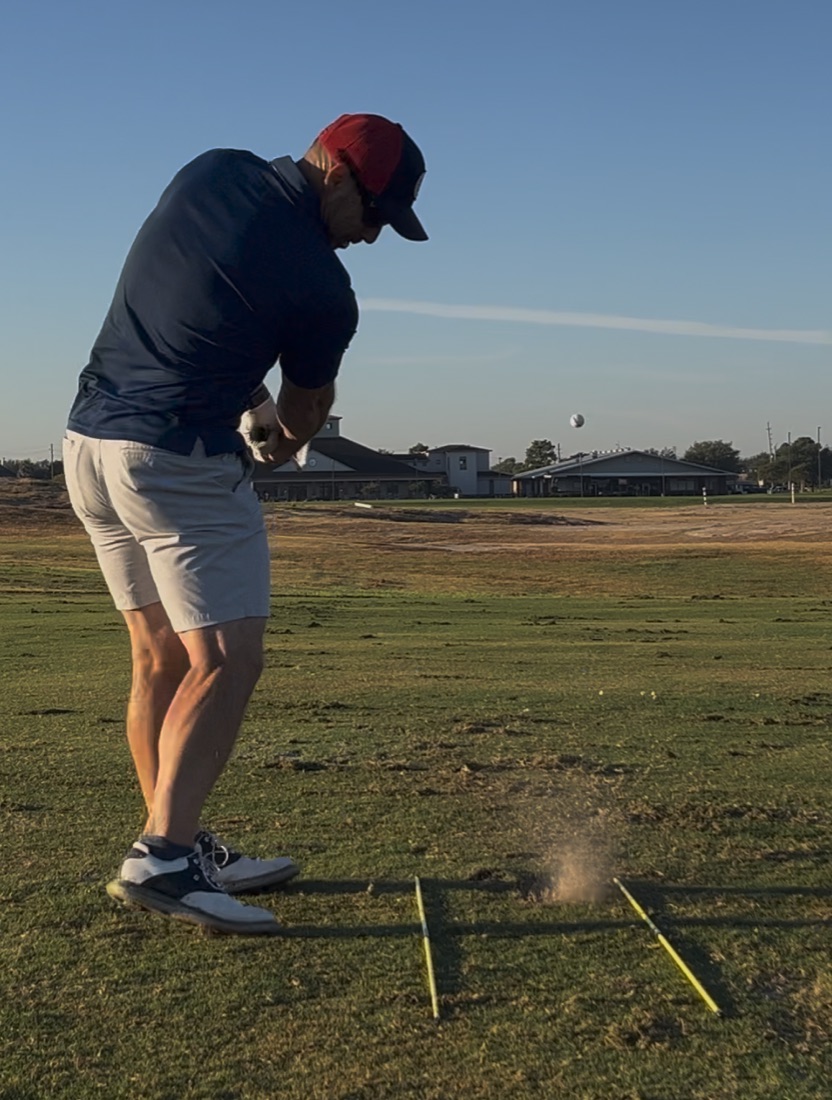
Setup: Place an alignment stick vertically in the ground directly behind your tailbone.
Execution:
- During backswing: maintain contact with the stick.
- During downswing: move your body toward the target to finish slightly ahead of the stick.
Why this works: Eliminates sway, which is a major cause of inconsistent low point and fat/thin strikes.
Time: 20 minutes (Days 1 and 2)
Drill 4: 2×4 Takeaway Drill (Unified Takeaway)
Objective: Encourage unified takeaway using arms and chest. Syncs up arms and body throughout the swing. Leads to better contact and low point control.
Not to mention, helps isolate an upper body turn to start the backswing which is excellent for limiting sway.
Setup: Place a 12-inch 2×4 a clubhead’s length behind the club at address.
Substitutes: You can use a golf ball or alignment stick, but the weight of the 2×4 makes this work best.
An excellent alternative for when you’re at home is to use an impact bag on a smooth surface.
Execution: Push the 2×4 straight back away from the ball during takeaway, using both arms and chest in unison.
Time: 20 minutes (Days 3, 4, and 5)
Recommended Practice Schedule
Day | Contact Combine | Brush Grass | Tempo | Sway | Takeaway | Total |
|---|---|---|---|---|---|---|
1 | 10 min | 5 min | 5 min | 20 min | — | 40 min |
2 | 10 min | 5 min | 5 min | 20 min | — | 40 min |
3 | 10 min | 5 min | 5 min | — | 20 min | 40 min |
4 | 10 min | 5 min | 5 min | — | 20 min | 40 min |
5 | 10 min | 5 min | 5 min | — | 20 min | 40 min |
Run Contact Combine assessments at the start and end of each session.
Troubleshoot Distance Control Breakdowns
Start with the Contact Combine assessments. They’ll show you whether it’s a low point problem (fat/thin) or a strike problem (toe/heel).
Symptom Log
Record precise symptoms:
- Inconsistent ball speed.
- Toe/heel contact.
- Fat or thin strikes.
- Unexpected spin variability.
- Setup errors.
Plus conditions: club, lie, tee height, wind.
Use foot spray or face tape to capture objective impact data. Use video if you’ve got it.
Diagnose With Contact Combine
Run the two assessments:
Ball-first contact test: Are your divots starting ahead of the line? If not, low point problem.
Sweet spot test: Are you hitting 7+ out of 10 on center? If not, strike problem.
Match Problem To Drill
Low point issues (fat/thin):
- Run Sway Drill to eliminate lateral movement.
- Run Brush the Grass to dial in ground contact.
Strike issues (toe/heel):
- Run 2×4 Takeaway Drill to sync arms and body.
- Run Tempo Drill to smooth out transition.
Isolate One Variable
Change only grip, then only stance, then only ball position.
Hit 10 shots per change. Track results using Contact Combine protocol or launch monitor.
Identifies whether setup, swing path, or equipment causes inconsistency.
Final Validation
After working the drill for 20 minutes, run Contact Combine again.
Compare ball-first contacts and sweet spot hits to baseline.
If you’re not seeing improvement (at least +2 in either category), the issue might be equipment-related or you need eyes from a PGA golf instructor.
Club Selection Rules For Course Strategy
Simple rules beat complex calculations under pressure.
Calibrated Yardage Protocol
Record 10-shot median carry distances and total distances for every club on calm days.
Use a launch monitor or range sessions. Log carry versus rollout.
Recalibrate after equipment changes.
Use carry for hazards. Use total for fairway-to-green decisions.
Margin-For-Error Yardages
Assign conservative, target, and aggressive yardages per club based on median dispersion.
Example (My 7-iron):
- Conservative: 160 yards
- Target: 165 yards
- Aggressive: 170 yards
Use conservative numbers for hazards or tight pins. Target for open greens. Aggressive only with clear bailout.
Wind, Elevation, And Lie Adjustments
Test and measure your personal adjustments.
Hit shots in different winds. Record the results. Build your own feels based on real data—not generic formulas.
Every swing is different.
Turf Contingencies
It’s not a terrible idea to get yardages – carry and roll out – from light and even moderately heavy rough.
You will be hitting from both of those, so why not be dialed in.
Tech And Low-Tech Workflows
You don’t need a $15,000 TrackMan to improve.
Decision Matrix
Gold standard (rent or buy): TrackMan or GCQuad at a simulator or fitting studio—rent an hour for precise spin and carry data.
Consumer launch monitors ($500-700): Garmin R10, Rapsodo MLM2 Pro, VoiceCaddie SC4—what most serious golfers own.
Not as accurate shot for shot, but you’ll get pretty close when you take averages.
Low-tech (free): Foot spray or face tape + markers + range finder.
Three Workflows
Tech-first (if you own a launch monitor):
- Make sure it’s calibrated and good to go.
- Record baseline 10 solid shots per club.
- Record relevant numbers.
- Log in spreadsheet with date/conditions.
Hybrid (simulator rental + home practice):
- Rent simulator for 1 hour.
- Run 10-shot Contact Combine per club on monitor.
- Record carry/total/spin for each club.
- Use that data for next 4-6 weeks of home mat practice.
- Validate with foot spray on Contact Combine assessments.
Low-tech (range or home mat):
- Use foot spray for Contact Combine assessments.
- Fixed markers for landing zones (or range yardage signs).
- Metronome for tempo.
- Log 10-shot medians per club in spreadsheet.
Calibration And Cross-Check
If using a consumer launch monitor, validate it occasionally:
- Hit 10 shots on the monitor.
- Immediately hit 10 shots to a marked target (rangefinder measured).
- Compare carry distances—should be within 3-5 yards.
Track Progress
Simple spreadsheet works.
Log:
- Date.
- Club tested.
- Contact Combine results (ball-first hits, sweet spot hits out of 10).
- Median carry distance.
- Conditions (temp, wind, ball).
- Notes (what felt good, what didn’t).
Compare week 1 to week 4. You’ll see the numbers move.
Iron Distance FAQs
1. What Is The 70/30 Rule?
The 70/30 rule is commonly referenced in golf instruction. Some teachers use it to describe swing effort (70% power, 30% control). Others use it for practice allocation.
Test what works for your game.
2. How Does Altitude Change Iron Distances?
The exact amount varies by swing speed, ball type, and conditions. Test your own clubs at different elevations to build personal adjustments.
Higher altitude reduces air density, which affects carry distance.
3. How Many Yards Does A Toe Or Heel Miss Cost?
Toe and heel strikes lose distance. How much depends on impact location, club, and your swing speed.
Use ball-flight data and impact tape during practice to quantify your typical loss. Fold that into your calibrated yardages.
4. Can A Club Fitting Change My Iron Distances?
Yes—fitting can alter effective loft, shaft length, and launch conditions, producing meaningful distance and dispersion changes.
After any fitting, remeasure your yardages using the Contact Combine 10-shot protocol to update your calibrated numbers and confirm real-world gains.
5. How Should I Adjust Yardage For Strong Wind?
Wind affects every golfer differently based on swing speed, ball flight, and trajectory.
Hit shots in windy conditions. Record actual yardage changes. Build personal adjustment numbers based on your data—not generic formulas.
Final Thoughts On Iron Distance Control
Iron distance control isn’t sexy.
But it’s what separates golfers who shoot in the 70s from golfers who shoot in the 80s and 90s.
When you know your real carry distances—not your best-ever unicorn strikes, but your 10-shot median from the Contact Combine—you make better decisions.
You pick the right club. You commit to the shot. You stop second-guessing yourself over the ball.
The system is simple:
- Run Contact Combine assessments (ball-first contact + sweet spot hits)
- Work the drills (Brush the Grass, Tempo, Sway, 2×4 Takeaway)
- Track improvement (start vs. end of session)
- Build your calibrated yardage chart over 30-50 shots per club
- Apply on the course with wind/lie adjustments
Use a launch monitor if you’ve got one (Garmin R10, Rapsodo, or rent time on TrackMan). Use foot spray and markers if you don’t. Both work.
Track your greens in regulation percentage over the next month. You’ll see it move.
That’s what iron distance control is about.
References
- TrackMan. “What is Launch Angle? Maximize Your Golf Shots.” TrackMan Golf Blog. https://www.trackman.com/blog/golf/launch-angle
- TrackMan. “TrackMan Average Tour Stats.” TrackMan Golf Blog. https://blog.trackmangolf.com/trackman-average-tour-stats/
- “How To Control The Distance Of Your Irons.” YouTube. https://www.youtube.com/watch?v=j-7DlpKtVMA
- Westerdahl, Chris and Boudreaux, Jamie. “Iron Game Secrets Cheat Sheet.” Golfer Geeks. 2024.