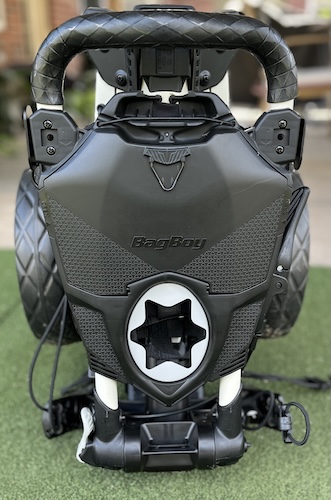
Storage & Accessories (Especially an umbrella holder)
Ease of opening and closing.
Does it store easily? Is it compact when folded up?
Our Scoring Scale Explained
Score
Meaning
5
Among The Best in the Category
4
Very Good
3
Average / Acceptable
2
Below Average
1
Poor
0
☠️
Scores are relative to the category. A full-size push cart is judged on folding and storing against other full-size carts, not against compact travel carts. So a 5 for folding and storing on a full-size cart means it’s among the easiest full-size carts to fold and store that I’ve tested. It doesn’t mean it folds as small as a travel cart. The same goes for every category and every type of cart.
How I Test Push Carts
I take each cart out for a full 18 at my home course in Houston. From the parking lot, to the practice area, on the course – one round tells you everything you need to know about how a cart rolls, steers, and holds up. I note how fast & easy it opens and closes, whether my bag stays put, and how it fits in my trunk. In Houston heat, the umbrella holder isn’t optional.
We earn a commission if you make a purchase, at no additional cost to you.
The Scorecard
Build Quality4
Storage4
Roll4
Accessories4
Maneuverability4
Folding / Unfolding / Storing4
Stability4
Value3
The Clicgear Model 4 has been on our list for years for a reason…or two.
What we like:
Rolls & maneuvers well.
Premium materials and construction.
Folds to a decently compact size.
Handy storage for your phone, balls, scorecard, tees, etc.
The Umbrella holder is a lifesaver when it’s sunny and hot.
What we don’t like:
Poor instructions.
Opening it and closing it the first couple of times was a bit of a chore.
Maybe I’m not great at instructions, and opening Model 4 didn’t seem intuitive to me.
But it’s easy and quick once you get the hang of it.
It checks all the boxes, and the price isn’t bad either.
Quality material and solid construction mean It’ll be around for a while.
August 2026 note: Clicgear’s current catalog has moved on to the Model 4.5 — the cart we tested and review here is the Model 4, which is still widely sold. We’ll put the 4.5 through the same course testing when we can get our hands on one.
We earn a commission if you make a purchase, at no additional cost to you.
The Scorecard
Build Quality5
Storage3
Roll4
Accessories4
Maneuverability3
Folding / Unfolding / Storing4
Stability3
Value4
The IP2 is the coolest looking cart on this list.
What we like:
Exceptional build quality.
Easy open and close.
Good roll quality. Excels on flat terrain.
Large selection of high-quality accessories you can buy.
Lightweight. Folds flat. Easy to transport.
Reasonable price.
What we don’t like:
Not the most maneuverable.
Small handle doesn’t give you enough leverage.
I appreciate the IP2, but prioritize an easier experience from my push carts.
This thing is like a drag racer. It excels in straight lines and gentle turns. It’s made to be sleek. It’s made to be minimal. It’s made to be light. It’s made to fold away to the size of a credit card (not quite).
It’s sleek, elegant, made of quality material, and constructed very well.
I think Big Max achieved exactly what they wanted with the IP2.
The Blade IP2 requires more attention over uneven terrain than i’m willing to give.
It is plenty highly rated by customers and there’s definitely a market for it. Just not the casual walker like me.
To be fair – I don’t use push carts often. A more experienced user may maneuver the IP with much less effort.
Fair question — every cart on this list sits in the premium tier, and the budget names come up constantly in reader questions: CaddyTek’s CaddyLite series most of all, plus the Costway and Goplus carts you’ll see all over the shopping results.
Here’s our honest position: we haven’t course-tested a budget cart yet, so none of them gets a scorecard or a ranking on this page. That’s the deal here — “Course Tested & Approved” means exactly that.
What we can tell you from years of testing the premium tier: the money buys you roll quality, stability on slopes, and hardware that survives seasons of folding and trunk time. Those are precisely the categories where cheaper frames give ground first. If you walk a few times a year on a flat course, a budget cart may be all you need. If you walk weekly, the premium carts above are the better long-run spend.
We plan to put a CaddyLite on the course and score it like everything else. When that happens, it earns a numbered spot — not before.
What to Look For in a Golf Push Cart
Quality push carts vary significantly in construction, features, and usability. Focus on these key factors:
Build Quality & Materials
Premium materials and solid construction determine longevity. Look for:
Aluminum or quality steel frames (not thin steel tubing)
Solid wheel construction with quality bearings
Reinforced stress points at joints
Quality fasteners and hardware
Push carts from Bag Boy, Clicgear, and Sun Mountain consistently use premium materials. Big Max offers exceptional build quality but may sacrifice some functionality.
Roll & Maneuverability
Your push cart must roll smoothly over various terrain—flat fairways, uphill climbs, downhill slopes, and side hills.
Key features:
Large wheels (10″+ diameter) for better rolling over obstacles
Quality bearings for smooth operation
Swiveling front wheel for 3-wheel models (highly recommended)
Wide wheelbase for stability
Responsive steering without excessive effort
Test rolling the cart before buying if possible. The difference between good and great rolling is immediately noticeable.
Opening, Closing & Storage
You’ll open and close your cart every round. Poor designs create frustration.
Look for:
Intuitive opening/closing without consulting instructions
No pinch points that catch fingers
Opens fully with minimal steps (1-2 steps ideal)
Folds to compact size for car trunk storage
Lightweight enough to lift into vehicle (under 20 lbs preferred)
Bag Boy carts excel here with intuitive operation. Clicgear carts have learning curves but become easy with practice.
Stability
Stability matters more than most golfers realize, especially on sloped terrain.
Consider:
Wide wheelbase prevents tipping on side slopes
Low center of gravity when bag is mounted
Quality bag securing system (straps or Top-Lock)
Brake system for parking (foot brake or hand brake)
The Bag Boy Nitron Auto-Open offers exceptional stability from its wide base design.
Storage & Accessories
Sufficient storage keeps essentials accessible without cluttering your bag.
Essential storage:
Large accessory compartment for rangefinder, phone, wallet, keys
Beverage holder (preferably insulated)
Ball storage for 3+ balls
Scorecard holder
Umbrella holder (critical in sunny/rainy climates)
Bonus accessories:
GPS/phone mount
Seat attachment
Sand bottle holder
Extra beverage holders
Value Consideration
Quality push carts are premium investments, typically ranging from $225 to $350+. These carts last 5-10+ years with proper care, making them worthwhile investments for regular walkers who want reliability and performance round after round.
3-Wheel vs 4-Wheel Push Carts
Choosing between 3-wheel and 4-wheel push carts depends on your course terrain, storage needs, and maneuvering preferences.
3-Wheel Push Carts
Advantages:
Superior maneuverability, especially with swiveling front wheel.
Easier to navigate tight spaces and sharp turns.
Typically lighter weight.
Better for hilly or sloped terrain.
Most models fold more compactly.
Disadvantages:
Slightly less stable than 4-wheel carts on severe side slopes.
Requires more active steering.
Best 3-Wheel Options:
Bag Boy Nitron Auto-Open: Very stable 3-wheel with auto-open
Clicgear Rovic Swivel RV1s: Best value with excellent maneuverability
4-Wheel Push Carts
Advantages:
Maximum stability on all terrain types.
Less active steering required.
Better for beginners or those wanting set-it-and-forget-it operation.
Typically more stable when parked.
Disadvantages:
Less maneuverable than 3-wheel carts.
Harder to navigate tight spaces.
Usually slightly heavier.
May not fold as compactly.
Best 4-Wheel Options:
Bag Boy Quad Pro: Premium 4-wheel with Top-Lock system
Clicgear Model 4: Proven quality with ample storage
Sun Mountain PX4: Solid value option
Our Recommendation
Choose 3-wheel carts with swiveling front wheels for best all-around performance. They offer superior maneuverability without sacrificing much stability, especially models like the Bag Boy Nitron Auto-Open with wide-base design.
Choose 4-wheel carts if you play extremely hilly courses with severe side slopes, are new to push carts, or want maximum stability when parked.
What About Electric Push Carts?
This guide covers manual push carts — the ones you push. Electric and remote-control trolleys are a different animal at a very different price, with motors, batteries, and remotes doing the walking for you.
We’ve course-tested one: read our Stewart Golf VertX remote trolley review to see what the top of that market looks like. If the electric category grows on this site, it gets its own guide — it won’t be squeezed into this ranking, because pushing a cart and steering a motorized one aren’t the same purchase decision.
FAQs
What is the best golf push cart?
The best golf push cart in Golfer Geeks testing is the Bag Boy Nitron Swivel, which scored 5 out of 5 in all eight categories.
Editor’s Pick: Bag Boy Nitron Swivel, 5.0 out of 5
Runner-up: Bag Boy Nitron Auto-Open, 4.6 out of 5
Best 4-wheel cart: Bag Boy Quad Pro, 4.2 out of 5
Which golf push cart is the best value for money?
The Clicgear Rovic Swivel RV1S is Golfer Geeks’ best value golf push cart. It is the former Editor’s Pick, with a swiveling front wheel and 5 out of 5 scores for roll, maneuverability and stability.
How much weight can a push cart hold?
A push cart can hold ~35lbs, the weight of the average golf bag with your clubs and accessories in it.
Do cart bags fit on push carts?
Yes, most cart bags fit on push carts.
Are 3-wheel or 4-wheel golf carts better?
3 wheel golf carts are better if the front wheel swivels (in our opinion). Otherwise, they are pretty close. Head to your local golf store and roll a few of them around to get an idea for yourself.
Is buying a push cart worth it?
A push cart is worth buying if you intend to walk occasionally or often during your rounds. Carrying a bag for 18 holes is harder than you think
Are Clicgear carts good?
Yes, Clicgear carts are excellent. The Rovic Swivel RV1s (4.4/5 score) was our former Editor’s Pick, offering exceptional roll, maneuverability, and construction at a great price. The Model 4 (4.0/5) delivers proven quality with premium materials. Clicgear pioneered many push cart innovations and maintains reputation for durability and performance.
How long does a golf push cart last?
A golf push cart should last many years if you take care of it.
Do most golf courses allow push carts?
Yes, most golf courses allow push carts.
Is walking in golf good exercise?
Yes, walking in golf is good exercise.
How much does a golf push cart cost?
The premium, course-tested carts in this guide typically run $225 to $350+. Budget brands like CaddyTek and Costway sell basic three-wheel carts for well under that — what you give up is build quality, roll, and stability, which is exactly what our scorecards measure. See “What About a Budget Push Cart?” above.
What is the best golf push cart for the money?
Of the carts we’ve course-tested, the Clicgear Rovic Swivel RV1S is the value pick — a former Editor’s Pick that scores 4.4/5 and checks all the boxes at what we called an unreasonably good price in testing. If you want the cheapest possible way into walking, read our budget section above first.
Final Verdict
I would happily own many of the carts on this page.
I suggest you visit your local golf store and get your hands on a few to test them out.
Don’t be in a hurry. You’ll have this thing for a while.
I’ll be testing more carts in the coming weeks…and years.
Please leave any suggestions below, and I’ll see if I can get my hands on them.
Thanks for checking out our review of the best golf push carts in 2026.