
 Written ByJamie
- What Is a Draw?
- Grip: Make It Easier to Close the Face
- Stance and Alignment: Let Geometry Help You
- Ball Position: The Smallest Change with the Biggest Impact
- Swing Path: Built in the Setup, Confirmed in Motion
- Impact and Release: Let the Body Shape the Shot
- Drills That Build a Repeatable Draw
- How to Practice It
Learning how to hit a draw with an iron some mystery.
You master a thing or two in the setup. You get a couple other concepts dialed in. You put in the work to make them yours.
Viola, you now know how to hit a draw.
I’ve played a draw for decades at this point, but I’m no expert on teaching this stuff. So I went out and found experts like Adam Porzak and Sean Foley (plus others) as the sources for this guide.
You’ll learn what causes a draw, what the numbers look like, how to set up for it, and which drills build it fastest.
What Is a Draw?
For a right-handed golfer, a draw starts slightly right of the target and curves gently back to the left. (Left-handers, reverse everything.)
The cause is simple:
A draw happens when the clubface is closed relative to the swing path at impact.
Not closed to the target. Closed to the path.
That distinction matters. If the face is closed to the target line, you’ll pull or hook it. If it’s closed relative to an inside-to-out path, the ball starts right and curves back.
If your contact isn’t predictable yet, spend time building reliable iron ball striking before focusing on shaping shots. A draw built on inconsistent contact won’t hold up under pressure.
What the Launch Monitor Should Show
If you’re measuring it, a stock iron draw typically looks like:
- In-to-out path: +1° to +5°
- Face-to-path: 0° to -4° (slightly closed to the path)
- Spin axis: -3° to -10° (left tilt)
- Lateral movement: 3–15 yards right-to-left
If the ball starts right, curves left, and your face-to-path is slightly negative, you’re hitting a real draw — not a pull and not a hook.
A draw is built on predictable contact and face control. If you’re still fighting inconsistent strike, start with our iron contact and compression guide before working on shot shaping
Grip: Make It Easier to Close the Face
Start with the grip because it quietly controls everything.
Rotate both hands slightly to the right so you can see two to three knuckles on your lead hand at address. This slightly stronger grip makes it easier to deliver a face that’s closed relative to the path without flipping the club.
One of the most common amateur mistakes is excessive lead-wrist cupping at the top of the backswing. If the lead wrist is cupped, the face is open. From there, you either block it or aggressively flip it to square it.
Instead, aim for a flat or slightly bowed lead wrist through the swing. Check this in a mirror before you hit balls. Keep the change subtle — too strong and you’ll start over-drawing it into hooks.
Stance and Alignment: Let Geometry Help You
Most golfers try to manufacture a draw with their hands. That’s backwards. The path is largely set up before the club even moves.
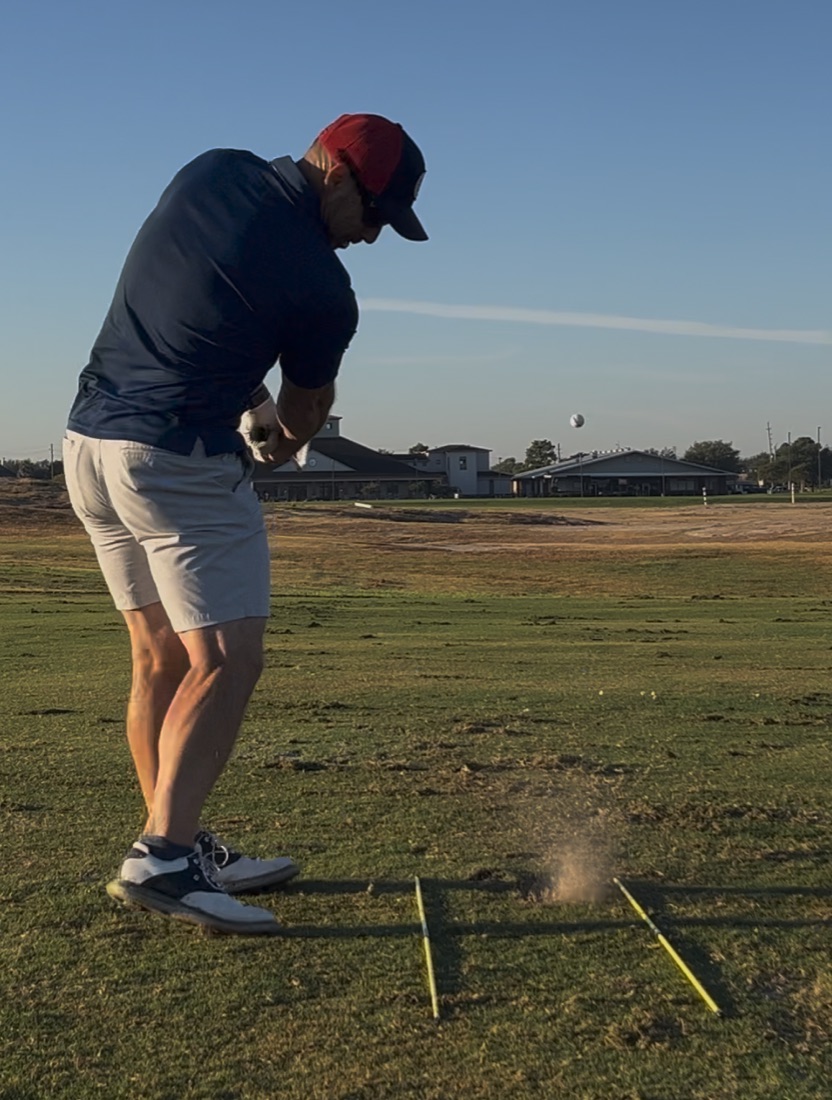
A simple adjustment that works: drop your trail foot back an inch or two. That closes your stance slightly and encourages the club to travel more around your body instead of up and over it.
Here’s the cleanest mental model:
Your feet aim where you want the ball to start.
Your clubface aims where you want the ball to finish.
That alignment alone simplifies shot shaping more than any swing thought.
The Reverse-K Setup
Add a slight hip bump toward the target at address. This creates a mild “reverse K” look — lead hip slightly forward, spine tilted slightly away from the target.
This setup:
- Loads pressure into the inside of your trail foot
- Reduces sway
- Promotes centered rotation
If you feel like you’re sliding in the backswing instead of turning, you’re building a slice pattern, not a draw pattern.
Ball Position: The Smallest Change with the Biggest Impact
Move the ball slightly back from your neutral iron position — about half an inch.
That small shift changes where the club meets the ball in the arc, naturally encouraging a more inside-to-out path. With a square face, this is often enough to produce a gentle draw without manipulating anything.
The key is subtlety. Half an inch is enough. Move it too far back and you’ll hit low hooks.
For a fade, you’d do the opposite — move it slightly forward. That’s how sensitive ball position is.
Swing Path: Built in the Setup, Confirmed in Motion
Once your stance and ball position are adjusted, the path is mostly handled. But there are two swing moments that determine whether you actually deliver it.
Takeaway
Let the club travel back along the line of your feet — not outside your hands. An early outside takeaway makes it extremely difficult to shallow the club and deliver an inside-to-out path later.
Keep the motion wide and connected to your body turn.
Transition
This is where most draws fall apart.
If the body spins aggressively from the top while the hands lag behind, the club gets stuck and the face stays open. That produces blocks or weak cuts.
A simple cue that works: keep your back to the target just a fraction longer at the top, then let the hands accelerate through the hitting zone. The hands have much farther to travel than the body. They can’t get outraced.
Patience first. Then speed.
Impact and Release: Let the Body Shape the Shot
At impact, your hands should be slightly ahead of the ball with forward shaft lean. The face is closed relative to the path — not shut to the target.
To help that happen, feel the lead forearm rotate so your knuckles turn down through impact. This is rotation, not flipping.
When golfers try to create a draw with their hands alone, they often chunk it because the body stalls. The body must continue rotating through the shot so the release happens naturally.
Another helpful image: instead of striking the ball directly from behind (6 o’clock), feel like you’re striking it from slightly inside — around 8 o’clock. That sensation promotes the correct path and face relationship without overthinking mechanics.
Drills That Build a Repeatable Draw
1. Headcover Path Drill
Place one headcover just behind the ball inside the target line and another just ahead of the ball outside the line. Swing between them.
If you hit the inside one, you’re too steep. If you hit the outside one, you’re over-the-top. The goal is to travel between them on a neutral-to-inside path.
Start with practice swings. Then hit balls without worrying about the result — focus on the path window.
2. Alignment Stick “Whoosh” Drill
Flip a club upside down or use an alignment stick. Swing and listen for the “whoosh.”
If you hear it before the ball position, you’re releasing too early. You want maximum speed just after impact.
This trains the timing that allows the face to square and slightly close relative to the path without flipping.
3. The Exaggeration Drill
If you lose your draw, exaggerate it.
Close your stance more than usual. Aim further right. Try to hit a big hook on purpose.
Feel the knuckles rotate down aggressively. Feel the inside strike.
Once you can produce the exaggerated version, dial it back into your normal setup. Most golfers find their best stock draw immediately after exaggerating the movement.
How to Practice It
You don’t need a complex program. You need focused reps with feedback.
Start with short swings and confirm center-face contact. Then move into one or two path drills. Finish with target practice at about 80% speed, shaping the ball deliberately right-to-left.
Track three things:
- Start line
- Curvature amount
- Strike location
When you can start the ball right consistently and curve it back without over-drawing it, you own the shot.
Troubleshooting Common Problems
If the ball slices right, your face is open relative to the path. Strengthen the grip slightly and confirm your wrist position at the top.
If the ball pushes straight right, your path may be too far inside or the ball may be too far forward. Move it slightly back and rehearse a more neutral body rotation.
If the ball hooks hard left, the face is too closed and/or the path is excessively inside-to-out. Weaken the grip slightly and reduce forearm rotation.
In all cases, check strike location first. Toe and heel strikes can distort curvature and make you chase the wrong fix.
FAQs
Can you hit a draw with every iron?
Yes, but the more loft the harder to draw. Especially sand and lob.
Why does my draw turn into a hook?
A hook happens when the clubface is too closed relative to the swing path. That usually means:
Grip is too strong
Forearms are over-rotating
Path is excessively inside-to-out
Check face-to-path first before changing anything else.
Do I need to swing harder to hit a draw?
No. A draw is about direction and face relationship, not effort. If you add speed before controlling the path, you’ll amplify curvature — usually into a hook or block.
Master the shape at 70–80% speed first.
Final Thoughts on How To Hit A Draw with Irons
A draw comes from three things:
A slightly closed stance.
A ball position that promotes an inside-to-out path.
A face that arrives just closed enough relative to that path.
Let the setup do most of the work. Let the body rotate through. Let the forearms respond naturally.
If you lose the shape, exaggerate it. Then dial it back.
Stay patient. Build the reps. Track the ball flight.
That’s how to hit a draw with an iron.
Sources
- HackMotion — How to Hit a Draw: 5 Best Swing Tips & Drills
- Sean Foley — How to Hit a Draw (Golf Digest)
- Porzak Golf — Draw Fundamentals, Body Rotation, and Feel Drills
- Porzak Golf — Backswing Plane, Transition, and Downswing Sequencing
- Porzak Golf — Shot Shaping Setup, Ball Position, and Starting Lines
- Todd Kolb — How to Hit a Draw on Command