
 Written ByJamie
- How the Rules Sort the Types of Golf Clubs
- Woods: Driver and Fairway Woods
- Irons: Numbered Clubs for Approach Shots
- Hybrids: A Stand-In for Long Irons
- Wedges: Short Shots Around the Green
- Putters: The Club for the Green
- Loft Ladder by Club Type
- How Many Golf Clubs in a Set
- Where to Start
- Questions Beginners Ask About Types of Golf Clubs
Walk into any golf shop and you’ll face a rack of clubs with numbers and names that explain nothing.
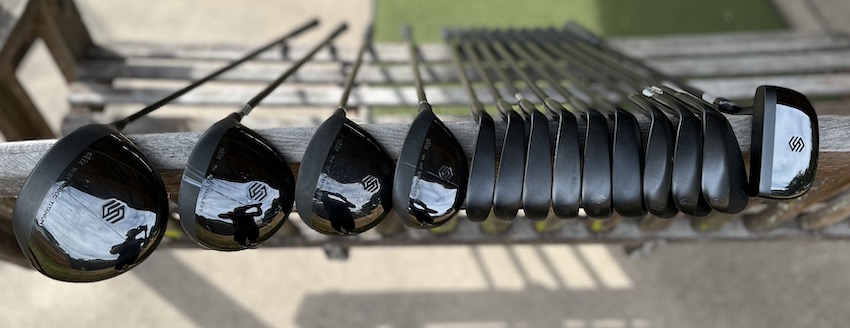
The types of golf clubs sort into five families: woods, irons, hybrids, wedges and putters, each with one job. The Rules of Equipment recognize three forms, woods, irons and putters, so the five families golfers shop for and the Rules’ three do not line up exactly.
Woods are for distance off the tee and long shots, irons for approach shots, hybrids are easier replacements for long irons, wedges are for the short game, and a putter is for the green. You can carry at most 14 clubs in a round, and a beginner needs fewer than that.
I’m Jamie, a 6.5 handicap who has been testing golf clubs since 2015. This page explains what each type is, what it does, and where to go next when you’re ready to decide what to carry.
How the Rules Sort the Types of Golf Clubs
The R&A’s Rules of Equipment describe clubs as coming in three forms, woods, irons and putters, distinguished by shape and intended use. The Rules of Golf don’t sort clubs the way a store shelves them.
The sorting turns on head shape. A wood head is relatively broad from face to back, and an iron head is relatively narrow from face to back. A putter is defined by loft and use, a club with a loft not exceeding ten degrees designed primarily for use on the putting green.
The Rules also acknowledge that hybrid, rescue and utility clubs blur the wood/iron line, and they judge those on overall shape and size. That’s why the five families golfers shop for and the three forms the Rules recognize don’t line up exactly.

Woods: Driver and Fairway Woods
Woods are the distance clubs, with broad heads and low lofts. Loft is the angle of the clubface, and it sets how high the ball goes.
The driver is the wood built for tee shots. PING lists the G440 K driver at 9.0, 10.5 and 12.0 degrees of loft, a standard length of 46 inches with the stock ALTA CB Blue 50 shaft, and a 460 cc head. For context on that last number, the Rules cap the volume of a wood head at 460 cubic centimetres plus a tolerance of 10 cubic centimetres.
Fairway woods have more loft and shorter shafts than the driver, so they trade some distance for easier contact. In the Takomo Ignis D2 line, the 3-wood is 15 degrees at 43.25 inches, the 5-wood is 18 degrees at 42.5 inches, and the 7-wood is 21 degrees at 41.75 inches.
As the number on the club rises, the loft rises and the shaft gets shorter. The irons below follow the same loft pattern.
I primarily use fairway woods off the tee, a habit I explain in my Takomo Ignis D2 fairway wood review. As I wrote in my beginner irons guide, I went 3 or 4 years without hitting a driver, and my 3-wood was my workhorse. It’s shorter, more lofted, and significantly easier to make contact with.
If you’re deciding how much loft you need in a driver, my beginner drivers guide covers that, and the full test of the G440 K is in my PING G440 K driver review.
Irons: Numbered Clubs for Approach Shots
Irons are the narrow-headed clubs you use approaching the green. The higher the iron number, the more loft and the shorter the shot, so a 9-iron flies higher and shorter than a 6-iron.
In the Takomo Iron 101 MKII set, the 5-iron has 23 degrees of loft, the 6-iron 26, the 7-iron 29, the 8-iron 33, the 9-iron 38, and the two clubs at the end of the set, the pitching wedge and gap wedge, 43 and 48.
Working those figures out, the jump from one club to the next runs about 3 to 5 degrees in this set.
If you want to know how far each club should carry, my golf club distance chart covers that. For choosing a beginner set, my beginner irons guide is the page to read, and the full test of that Takomo set is in my Iron 101 MKII review.
Hybrids: A Stand-In for Long Irons
A hybrid is a club shaped between a wood and an iron. Its purpose is to do a long iron’s job with less skill required.
The Rules treat hybrids as straddling the wood/iron line, since they borrow from both. In the bag, a hybrid takes the place of a long iron.
I strongly recommend that first-time buyers choose hybrids over long irons. Hybrids are much easier to hit solid, they launch higher, they go farther, and they play better out of the rough. A golfer who is set on improving, and who will work on the skills long irons demand, can graduate to long irons later.
Whether a hybrid or a long iron suits you better is its own question. The hybrid vs iron comparison breaks it down, and the fairway wood side of the decision is covered in fairway wood vs hybrid.
Wedges: Short Shots Around the Green
Wedges are the high-lofted clubs for shots near the green. In the Iron 101 MKII set, the pitching wedge comes with the irons and the gap wedge sits right after it, and my own starter bag runs the irons through a sand wedge.
Wedge lofts climb in small steps. The Takomo Skyforger 002 wedge line comes in eight lofts, from 46 up to 60 degrees.
I’m keeping this section short on purpose, because wedge lofts are a whole topic of their own. The wedge loft chart lists wedge lofts by name, and my beginner wedges guide covers which to buy first.
Putters: The Club for the Green
The putter is the club for rolling the ball on the green. The R&A defines it by loft, a club with a loft not exceeding ten degrees designed primarily for use on the putting green, and it’s the one club exempt from the Rules’ general 48-inch maximum club length.
It’s also the club I call the most important in the bag, a stance I take in my beginner irons guide. Whatever putter you end up with, my beginner putters guide covers putter picks for new golfers.
Loft Ladder by Club Type
Putting the example numbers from the named product lines on a single ladder shows how loft climbs from driver to wedge.

In these examples the driver runs 9.0 to 12.0 degrees, the fairway woods 15 to 21, the irons 23 to 38 with the pitching and gap wedges at 43 and 48, and the wedge line 46 to 60. Every step up means the ball flies higher and shorter.
How Many Golf Clubs in a Set
The Rules of Golf cap you at 14 clubs for a round, though you can start with fewer and add during the round, up to the limit. Rule 4 is where that limit lives.
The practical answer for a beginner is that you don’t need all 14. A starting bag covers four jobs: a driver for the tee, irons for the fairway, a wedge or two around the green, and a putter.
In my Stix review I said you could even drop the gap wedge and lob wedge from their 14-club set and play with 12. For the full answer to how many golf clubs in a set, the club count guide owns the topic.
Where to Start
My suggested first bag is a driver, a 3-wood, a 6-iron through sand wedge, and a putter. A 5-wood is not a terrible idea and could even replace the 3-wood, and the 6-iron can be a 6-hybrid if that’s easier to hit.
I don’t believe you need any club longer than a 6-iron to start. Hybrids, a gap wedge around 50 to 52 degrees, and a lob wedge can all come later.
The full walk-through of which clubs to buy first is in what golf clubs do I need, and the clubs I’d point a first-time buyer to are in the clubs I recommend for beginners. Read those two, and you’ll know the types of golf clubs and what to do with each one.
Questions Beginners Ask About Types of Golf Clubs
What are the 14 clubs in a golf bag?
The 14 clubs in a golf bag are whichever 14 a golfer chooses, because the Rules set only a limit of 14 clubs for a round. A beginner does not need to fill all 14, and one suggested starter bag is a driver, a 3-wood, a 6-iron through sand wedge, and a putter.
How many clubs can a golfer carry in a round?
A golfer may carry at most 14 clubs in a round under the Rules of Golf, and a beginner does not need all 14.
How many types of golf clubs are there?
The Rules of Equipment describe three forms of golf club: woods, irons and putters, distinguished by shape and intended use. Golfers shop for five families: woods, irons, hybrids, wedges and putters. Those are the five types of golf clubs you’ll choose between.