
 Written ByJamie
Confession time…I get sloppy/lazy with my iron setup and ball position.
Not that I don’t know how important this is; it’s massive. I sometimes assume it doesn’t matter that much because I’m just a handicap golfer and the ball will go generally where i’m aiming.
That would be a bad assumption…
There’s a margin of error, but as sloppiness grows, the errors grow.
So, I put together this guide based on the best info I could find on the interwebs.
This guide synthesizes what these experts I’ve found recommend into something you can actually use at the range and on the course.
What Is Proper Iron Setup And Ball Position?
The baseline every instructor agrees on: your iron setup needs to promote a descending strike where the club bottoms out just after the ball.
PGA pro Todd Kolb breaks it down simply. For mid-irons:
- Feet shoulder-width apart
- Weight 60/40 toward lead foot
- Soft knee flex
- Spine tilted forward from hips (not rounded)
- Shoulders parallel to target
Ball position sits between your logo and buttons at address. Short irons (8-9-PW) go center. Mid irons about one inch forward of center. Long irons 1 to 1.5 inches forward of center.
Hands sit slightly ahead of the ball with shaft tilting toward the target. This forward lean helps you compress the ball properly.
Quick check: record a down-the-line video. If your spine looks like you’re bending to pick something up and the ball sits roughly under your lead eye, you’re close.
How Ball Position Changes By Club
Here’s where we get specific, pulling from what multiple instructors recommend:
Short irons (PW, 9, 8): 1 to 1.5 inches back of center. Higher lofts need a steeper attack angle—the club bottoms out after the ball for compression and spin. Deepest divots happen here.
Mid irons (7, 6, 5): Center to one inch forward. Moderate lofts need the low point just ahead of the ball for balanced launch. Still hitting down, just not as steep.
Long irons/hybrids (4, 3): 1 to 1.5 inches forward of center. Lower lofts and longer shafts move your low point forward naturally. Flatter attack angle, still ball-first contact.
Fairway woods: 2 to 3 inches forward (inside lead heel). Shallow attack with low point at or behind the ball. Sweep, don’t dig.
Driver: Inside lead heel (most forward). You’re catching it on the upswing, low point behind the ball.
The Michael Breed T-bar system uses tape markers spaced 1.75 inches apart (golf ball diameter) to mark positions. Simple visual showing ball position only moves 6 to 7 inches across your entire bag.
How Stance Width Changes
Michael Breed recommends adjusting stance based on club length:
Long irons/hybrids: Widen stance one to two hand-widths. Less knee bend, more upright spine. Encourages shallower attack.
Mid irons: Shoulder-width stance. 10-20 degrees knee flex. Forward spine tilt. This is your baseline.
Short irons/wedges: Narrow stance by a hand-width. More knee flex. More forward tilt. Promotes steeper descent.
Stance width controls arc and stability. Knee flex times your weight shift. Spine angle sets where the club bottoms out. If you’re thin, add forward tilt. Fat means stand more upright.
Quick Diagnosis Checks
Visual check: At address, ball way left of center with a mid-iron means too far forward. Crowded under front foot means too far back. Todd Kolb’s method: feet together, ball centered, step with each foot—automatically centers it for mid-irons.
Check impact marks: Toe/heel marks = lateral issues. High/low scuffs = forward/back problems. Use impact tape over 10-15 shots.
Read divots: Divot behind ball or barely taking one = ball too far back. Divot at or before ball = too far forward or early weight shift.
Drills That Actually Work
T-square drill: Michael Breed’s go-to. One alignment rod through ball to target, another along lead foot forming a T. Slow turns, verify club tracks behind ball. Ten slow reps, then sets of five faster.
Gate drill: Two tees around ball. Bottom out after the ball, clip both tees. Half swings, then three-quarter, then full. Only speed up after consistent contact.
Simple practice routine: Hit 10 shots per iron moving ball forward/back to find your most repeatable strike. Note placement relative to lead foot, stance width, shot shape. Write it down. Create one-line checklist per club: “8-iron: shoulder-width, ball one inch left of center, forward tilt.” Keep it in your bag.
If you want more detail on general iron contact fundamentals, check out our guide on how to make solid contact with your irons.
Track Your Progress
Pick 2-3 metrics you’ll actually track:
Impact tape weekly: Toe/heel/center? Forward/back on face? Connect to ball position changes.
Divot photos: Where does it start relative to ball position? Forward = good. At or behind = problem.
Simple log: Date, club, stance width, ball placement, drill used, result. Review weekly, set checkpoints like “70% center strikes” or “divot starts 2 inches forward.”
You can’t improve what you don’t measure. Keep it simple and consistent.
Ball Position FAQs
Does wind change ball position?
Minor adjustments, yeah. Ball slightly back for lower trajectory into headwind. Slightly forward for higher flight with tailwind.
How does turf firmness matter?
Soft turf benefits from slightly forward position to avoid digging. Firm turf favors more central. Just a few inches difference.
Can alignment sticks fix position issues?
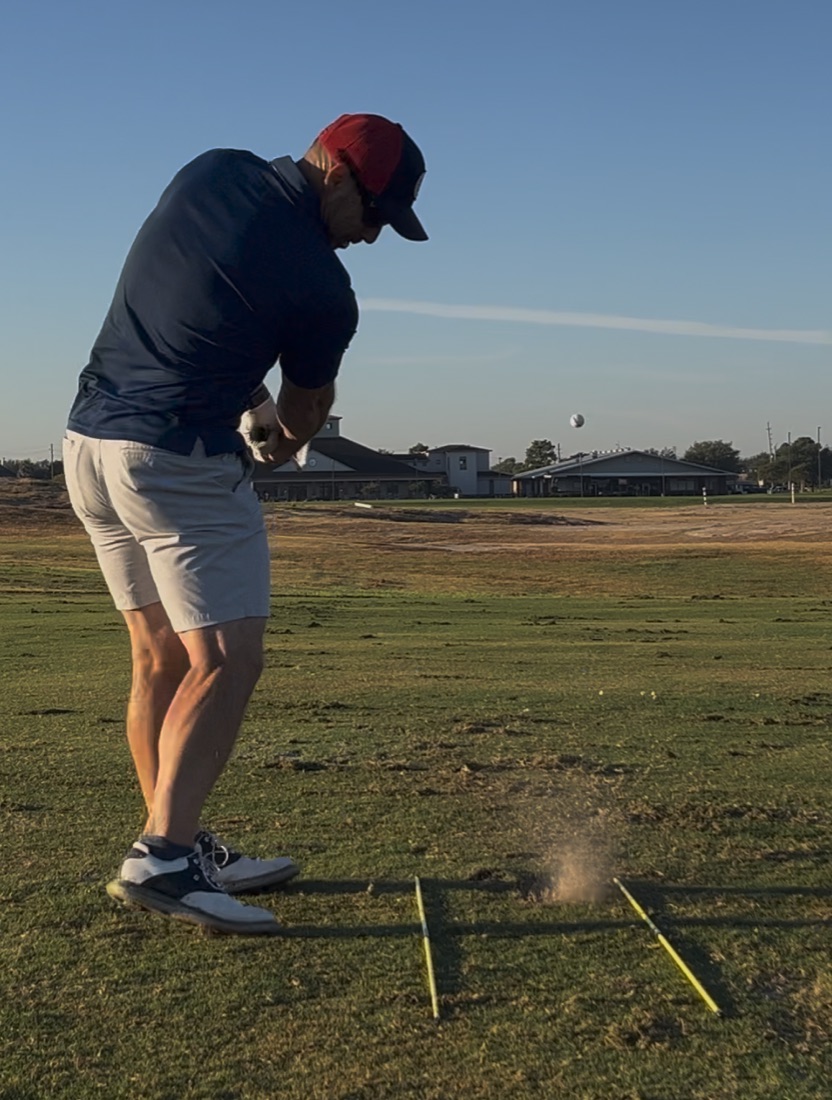
Absolutely. One along toe line confirms ball location. Second parallel to target keeps you honest during practice.
Final Thoughts on Iron Setup and Ball Position
Getting ball position for irons right isn’t complicated.
Short irons center of stance to slightly back.
Mid-irons about an inch forward of center.
Long irons 1.5 inches forward of center.
Adjust your stance width and spine angle as clubs get longer or shorter.
Use the T-square drill and gate drill to groove it in. Track your divots and face strikes to make sure you’re actually improving.
The teaching pros all say the same thing—most amateurs play the ball too far forward with irons. Start everything at center and make small moves forward only for longer clubs.
Test it, measure it, and stick with what produces the most repeatable contact.
Thanks for checking out our guide on iron setup and ball position.
Sources
- How to Address the Golf Ball With Irons – Todd Kolb, PGA Teaching Professional
- Ball Placement for Irons: A Simple Guide – MyGolfSpy
- The Basics…Ideal Ball Position for Every Club – Michael Breed
- You Will Strike Your Irons Perfect If You Follow This Process – Danny Maude
- Golf Ball Position By Club (The Ultimate Guide) – Performance Golf