
 Written ByJamie
- What Is Iron Tempo And Transition?
- Why Does Tempo Matter For Iron Shot Consistency?
- What Are The Biomechanical Components Of Transition?
- How Can You Screen Mobility For A Stable Transition?
- What Metrics Should You Use To Assess Tempo And Transition?
- How Do You Measure Tempo With Simple On-Range Tools?
- What Objective Protocols Are Best For Tracking Transition Quality?
- What Drills Best Train Tempo During The Transition Phase?
Iron tempo and transition control everything about your iron game — contact, distance, dispersion, consistency.
Get the timing right between your backswing and downswing, and shots come off clean with predictable yardage. Get it wrong, and you’re chunking 7-irons and wondering why your distances are all over the map.
This guide breaks down what tempo and transition mean for iron play, how to measure yours, the drills that fix the most common faults, and a full 8-week progressive training plan with BPM targets by club.
If you’re working on hitting your irons better, tempo is one of the highest-leverage things you can fix. Here’s how to do it.
What Is Iron Tempo And Transition?
Iron tempo is the consistent rhythm and proportional timing between the start of your backswing and the start of your downswing.
It’s not about swinging fast or slow. It’s about the ratio between the two halves of your swing being repeatable, shot after shot.
Transition is that brief moment at the top of the swing where upward motion becomes downward motion. You can spot it by watching for clubhead deceleration, initial weight shift toward the lead foot, and subtle changes in wrist set.
It’s the hinge point of the entire swing.
When tempo and transition are synchronized, the clubface squares up, the shaft loads properly, and weight transfers in sequence.
The result is repeatable contact, consistent launch angle, and predictable distance.
When they’re off, you get early casting, late release, inconsistent strike height, and chunked or thin shots. The clubhead path changes, effective loft shifts at impact, and dispersion widens.
Those aren’t swing flaws in isolation — they’re timing problems.
Why Does Tempo Matter For Iron Shot Consistency?
A repeatable swing tempo creates consistent clubhead speed, which makes impact location on the face predictable. That’s the whole game with irons — knowing where the ball is going to land.
Rush the transition, and the face tends to close. You get hooks or low draws you didn’t plan. Decelerate through impact, and the face stays open — slices and weak cuts.
Inconsistent tempo also messes with your distance gaps. Variable peak speed and premature deceleration shift launch angle and spin rate, which widens your carry spread. A smooth, repeatable tempo with a 7-iron will give you a noticeably tighter distance window than a jerky one.
The performance consequences compound under pressure. Thin and fat strikes increase. Left-right dispersion widens. Yardage gaps become unpredictable. When you don’t trust your distances, course management falls apart.
What Are The Biomechanical Components Of Transition?
The downswing transition follows a specific sequence called the kinematic sequence: pelvis fires first, then the torso accelerates, then the arms, and finally the club.
Each segment decelerates as the next one speeds up — like a whip. Skip a step or fire out of order, and timing breaks down.
Weight shift: Your center of mass moves from back foot to front foot using ground reaction force. The timing window for this shift relative to pelvic rotation is tight.
Coach cues like ‘drive through mid-foot’ or ‘weight on front inside edge’ help. A single-leg pause drill into transition builds this feel.
Pelvic rotation and power storage: The hips open to create torque and store elastic energy. Common faults here are early hip collapse and lateral slide — both rob power and break tempo.
A simple hip rotation mobility test can tell you if physical restriction is the root cause.
Torso unwind and lag: Delayed trunk rotation preserves lag for the whip effect at impact. Lead-shoulder and sternum-path cues work well here.
A three-step cadence drill with holds at each position builds the feel of sequenced rotation.
Wrist release: This is the final link in the chain. It fine-tunes clubface angle and speed at impact. Premature release is one of the most common amateur faults.
An impact tape drill (focusing on contact sound and location) helps isolate this.
How Can You Screen Mobility For A Stable Transition?
Physical restrictions are often the hidden cause of tempo problems. Before blaming your swing, check whether your body can actually do what you’re asking it to do.
Ankle dorsiflexion (knee-to-wall lunge test): Less than 10 cm of range predicts calf/ankle restriction that forces early heel raise. That destabilizes the base of your downswing transition.
Hip internal rotation: Seated internal rotation test — rotate your thigh inward and measure how far your foot kicks out.
TPI data shows the average PGA Tour player has over 45 degrees of internal hip rotation on both sides. Under 40 degrees for golfers suggests pelvic compensation that alters weight shift and transition sequencing.
If the hips can’t rotate freely, something else has to give — usually your tempo or your lower back.
Thoracic rotation: Seated thoracic rotation with a neutral lumbar spine. TPI’s torso rotation test checks your ability to rotate the upper body independently from the lower body.
If this is restricted, the lumbar spine compensates, which breaks tempo control and adds injury risk.
Single-leg dynamic control: Single-leg squat to 45 degrees and a 10-second single-leg balance (eyes open). Valgus collapse or trunk sway points to stability deficits that leak energy during transition.
Prioritize corrections in order: ankle mobility first, then hip mobility, then glute and core stability. Re-test every few weeks to track improvement.
What Metrics Should You Use To Assess Tempo And Transition?
Tempo ratio: The numeric relationship between your backswing and downswing time.
The commonly cited ratio is 3:1 — your backswing takes roughly three times as long as your downswing. A stable ratio between 2.5:1 and 3.0:1 indicates repeatable tempo.
Ratios below 2.0 suggest you’re rushing the transition. You can measure this with slow-motion video or apps like Tour Tempo and the V1 app.
Backswing and downswing BPM: Record each separately using a metronome, an inertial swing analyzer, or high-frame-rate video.
Practical ranges: backswing 60–80 BPM, downswing 180–240 BPM. Large mismatches signal timing breakdowns or excess tension.
Sequencing timing: Measure the gaps between pelvis rotation, thoracic rotation, arm slot, and club release.
Early pelvis or late release degrades clubface control. Segmented drills and slow-motion video chaining help correct sequence issues.
Clubhead speed consistency: Track mean speed and standard deviation across 10 swings using a swing speed radar or swing analyzer.
A standard deviation above 5–7% flags inconsistent tempo. Reduce swing freedom and focus on tempo stabilization reps until variance narrows.
Note: BPM (Beats Per Minute): The number of beats a metronome clicks per minute. Higher BPM = faster tempo. In tempo training, you sync your backswing to one beat and your downswing to the next to build repeatable rhythm.
How Do You Measure Tempo With Simple On-Range Tools?
You don’t need expensive gear to start measuring. Here are practical methods you can use on the range today.
Metronome app: Set BPM to 60–80. Take 10 swings and sync your backswing to one beat, downswing to the next. Count how many swings match. Adjust BPM until you hit 8–9 out of 10 consistent swings. That’s your working tempo target.
Watch or GPS watch: Time five consecutive swings, divide total seconds by five for seconds-per-swing, then convert to BPM (60 ÷ seconds-per-swing). Log three sets and average them to reduce noise.
Smartphone apps: Apps like the V1 app or Tour Tempo show seconds-per-swing or BPM. Follow guided tempo drills with 10–20 swings, record reported BPM, and repeat under consistent conditions.
Audible cues and partner counting: Use a steady ‘one-two’ count while taking 20 swings. Mark rushed vs. matched swings. Calculate your hit rate (matches ÷ total) for a quick consistency check.
Standardize your protocol: Use the same club, ball position, and warm-up each time. Perform three sets of 10–20 swings. Record BPM, seconds-per-swing, environmental notes (wind, fatigue), and hit-rate consistency. This gives you a trackable baseline.
What Objective Protocols Are Best For Tracking Transition Quality?
If you want precision beyond a metronome and feel, here’s how to set up repeatable tracking without overcomplicating it.
Video: 240 fps is plenty for full-swing review. Use two angles — down-the-line and face-on — with your phone on a tripod at a consistent height and distance each session. That consistency matters more than the camera.
Launch monitor or radar: Track clubhead speed, ball speed, launch angle, spin rate, carry, and smash factor. The key is logging data so you can correlate tempo changes with ball-flight outcomes over time.
Session structure: 10-minute dynamic warm-up, six progressive unrecorded swings, then 10 recorded swings per club. Use the same ball model, club, tee height, and surface every session. Without that consistency, session-to-session comparisons mean nothing.
What to track: Session mean, standard deviation, and BPM trendlines. Aim for at least three sessions per month. Flag changes beyond 1.5 standard deviations as worth investigating.
What Drills Best Train Tempo During The Transition Phase?
These are coach-validated drills focused specifically on tempo control during the transition.
3-count transition drill: With a mid-iron, take a smooth takeaway on ‘1’, pause at the top on ‘2’ to feel width, then start the downswing on ‘3’ with body rotation — not hand speed. Regress to a 2-count if needed. Progress by adding a metronome app at 60 BPM.
Club-specific wrist-hinge drill: With a pitching wedge, exaggerate a low-to-high wrist set. Cue ‘wrist then body’ to prevent early release. Start with half swings, then progress from 9-iron to 7-iron to build iron tempo transfer across clubs.
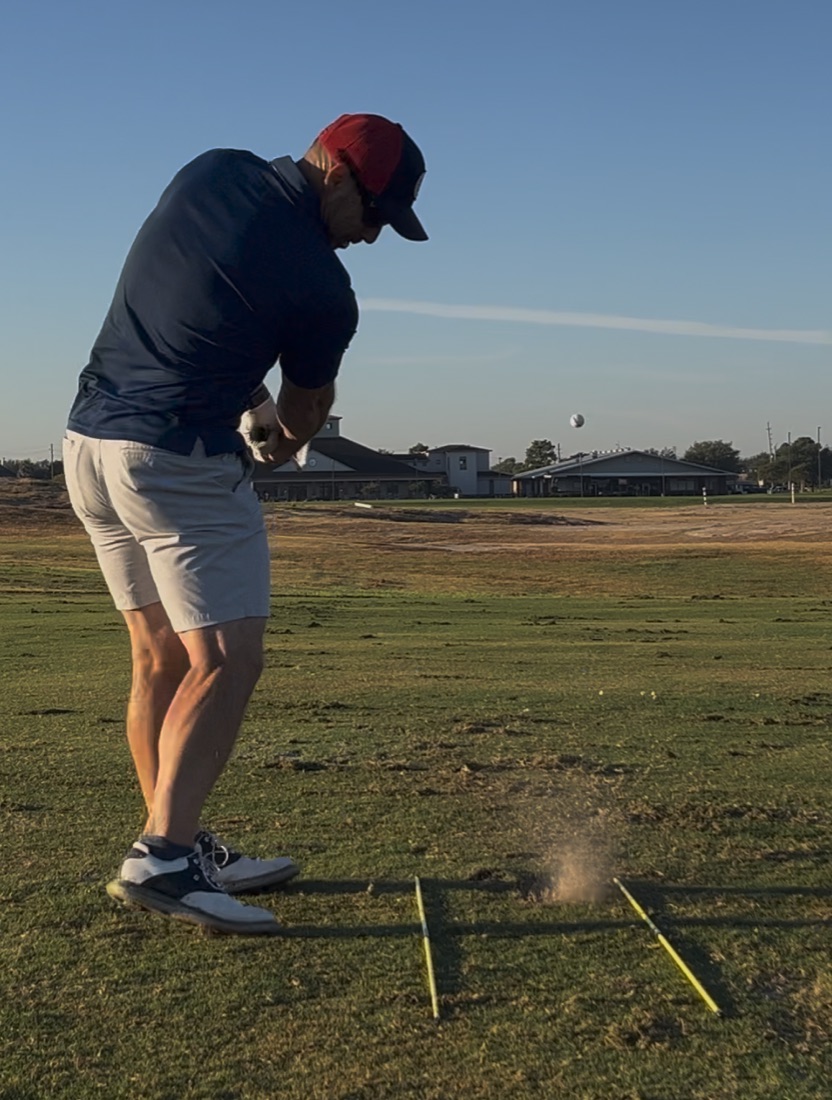
Gate-line drill: Place alignment sticks to create a narrow exit corridor. Cue a ‘smooth sweep’ through transition to avoid scooping. Regress using a tee for margin.
Progress by narrowing the gate or using a weighted training aid like the Orange Whip for tempo resistance.
Weight-shift tempo drill: Practice deliberate pressure shift to the lead foot across a 0.25-second window at transition. Start with static weight-shifts, then integrate full swings with impact tape to validate low-point and timing consistency.
Resistance deceleration drill: Attach a resistance band to the handle and a fixed point. Perform slow half-swings resisting tension to emphasize body-led rotation and controlled release.
Regress with a lighter band, progress by increasing tension or adding metronome counts.
Progressive distance drill (via Eric Cogorno): Take your 8-iron (or any mid-iron) and hit a series of full swings starting as short as possible — maybe 60 yards — and gradually build up to full distance.
The rule: every swing must be a full swing. You’re forced to control tempo to control distance. Somewhere between your slowest and fastest swing, you’ll find a tempo that feels best and produces the most consistent contact.
That’s your on-course tempo. Cogorno recommends this as both a practice drill and a warm-up routine.
How Should You Progress Tempo Drills Week By Week?
Week 1 — Baseline and awareness: Three sessions at 50–60% clubhead speed. Four sets of 8–10 submaximal swings at a 3:1 count (3-second backswing, 1-second downswing).
Record perceived effort and capture one slow-motion clip per session for baseline notes.
Week 2 — Add load and contrast timing: Four sessions with three sets of 6–8 swings at 60–75% speed. Alternate between 3:1 and 2:1 counts. Include a ladder drill that alternates slow/fast reps to train accelerated downswing transition.
Log BPM for each set using a metronome app or Tour Tempo cadence chart.
Week 3 — Near-game intensity: Three sessions, four sets of 4–6 swings at 80–90% clubhead speed using mostly 2:1 tempo. Add two full-speed target swings per session.
Capture video for frame-by-frame review to check iron tempo consistency and initial ball-flight changes.
Week 4 — Peaking and on-course integration: Two focused sessions. Warm up with two slow tempo sets, then perform 3–5 full swings at 95–100% speed maintaining drilled tempo cues.
Finish with one mixed-tempo simulated on-course session to test transfer under pressure.
Programming notes: Progress load before complexity. If tempo consistency drops for two consecutive sessions, reduce volume.
Log BPM, backswing:downswing ratios, club used, and ball-flight metrics to inform your next four-week block.
How Do You Integrate Tempo Training Into On-Course Practice?
Range tempo is one thing. Keeping it on the course is another. Here’s how to bridge the gap.
Build a pre-shot routine around tempo: Three seconds in, three seconds out on your breathing. Alignment check. Two practice swings at your target tempo. Execute. Repeat for every iron shot to build a consistent rhythm you can rely on.
Start with low-pressure holes: Use tempo cues only on par 5s or recovery plays first. Then add them to approach shots and short irons. Save tee shots for last — once your downswing transition and timing are consistent on approaches, you’ll have the confidence to apply it everywhere.
Shot-selection rules: Use your measured swing tempo and backswing-to-downswing ratio on mid and long irons for distance control. Shorten the backswing but keep identical rhythm for short game.
Don’t change your tempo when you need a guaranteed up-and-down.
Simulate match pressure: Score practice holes. Add small stakes or pair up with someone. Use a silent two-count cue to maintain tempo. Record success rates to see how your tempo holds up under stress.
Quick in-play cues: A silent ‘one-two’ count works. Monitor shot dispersion before raw carry — that’s the real indicator.
If you start chunking or hitting thin, run a quick diagnostic: test your tempo, isolate the fault (video or a two-feet-together drill), run a corrective drill, then validate.
How Should An 8-Week Progressive Iron Tempo Training Plan Look?
Here’s the full program, broken into four phases. Each phase builds on the previous one.
Weeks 1–2: Foundation and Baseline Testing
Establish your baseline swing tempo with a warm-up plus 10 controlled swings per club.
Record tempo in BPM, clubhead speed, ball speed, carry, and dispersion for your pitching wedge, 9-iron, 7-iron, and 5-iron.
Use a metronome app (Tour Tempo or V1 app) and a swing analyzer or radar for objective logging.
Target BPM ranges will vary by club — shorter clubs allow slightly higher BPM, longer clubs slightly lower — but focus on keeping your backswing:downswing ratio between 2.5:1 and 3.0:1 across all clubs.
Weeks 3–4: Motor Patterning and Tempo Consistency
Three sessions per week: two technical tempo sessions (three sets of 10 reps by club with 60-second rest between sets) plus one short-game integration session.
Progress from your target BPM minus 2 to your target BPM. The goal is to reduce tempo variance — your swings should start feeling the same.
Weeks 5–6: Load, Speed Transfer, and Transition Work
Add contrast sets: controlled tempo sets followed by 3 intent swings at +4 BPM. Add rotational plyometrics once per week.
Use swing speed radar drills to transfer tempo gains into clubhead speed while preserving timing.
This is where tempo starts translating into actual performance.
Week 7: Specificity, Pressure, and Robustness Testing
Simulate on-course scenarios with mixed-club rounds using metronome cues, timed routines, and variable BPM drills. Test how well your downswing transition holds up under pressure and fatigue.
This week exposes weaknesses before the final test.
Week 8: Taper, Retest, and Next Steps
Repeat your baseline tests under identical conditions. Compare Week 1 vs. Week 8 tempo, clubhead speed, carry, and dispersion.
Use a troubleshooting flowchart to address any remaining gaps. Recommended maintenance going forward: three quality sessions per week plus on-course practice.
How Do You Adjust Tempo Training For Different Skill Levels?
Beginners: Teach a simple 3:1 backswing-to-downswing count at roughly 60–70 BPM using a metronome and half-swing reps. Two to three short sessions per week.
Prioritize consistent contact before adding speed. Use pendulum putting drills, slow towel-swings, and two-feet-together drills to build rhythm.
Intermediate players: Progress to a 2:1 ratio at 70–85 BPM. Add full-swing rhythm drills, impact-tape feedback, two-feet-together and pause-at-top drills.
Increase BPM or swing length after two weeks of consistent accuracy. Progress through 9-iron to 7-iron to 5-iron tempo progressions.
Advanced amateurs: Train variable tempo windows (1.5:1 to 1:1) at 85–100 BPM with protocoled speed-burst drills, on-course pressure sets, and video analysis.
Use a 3:1 intensity cycle weekly — three lighter sessions, one speed session. Add randomized-club sets and simulated-pressure routines to transfer tempo to play.
Pacing rule: Only increase BPM or complexity after 7–10 consecutive quality reps under low fatigue.
Document ratios and BPM with a metronome app or swing analyzer and log results to validate improvement.
Got Questions About Iron Tempo?
These quick FAQs answer specific concerns not fully covered above. Each answer is concise and focused for immediate application.
Does tempo change with different clubs?
Yes. Longer, lower-lofted clubs (driver, 3-wood) generally use a slightly slower BPM and smoother transition than short, high-lofted clubs.
But the key is maintaining your backswing:downswing ratio (around 3:1 or 2.5–3.5:1) across all clubs. The ratio stays familiar even if absolute BPM shifts.
Longer clubs demand a wider body turn and delayed wrist unhinge. Shorter clubs use an earlier wrist release and steeper attack.
How does fatigue affect tempo and transition?
Fatigue slows movement initiation and reduces force output, which typically causes a faster or jerky downswing and early transition breakdown.
Watch for these signs mid-session: rest time creeping up by 10% or more, visible form breakdown (rounded posture, dropped elbows), and inconsistent contact.
When you notice fatigue, shorten your range of motion by 10–20%, lower effort, or switch to tempo-friendly half swings. Schedule tempo-focused work earlier in practice sessions when you’re fresh.
Can a metronome or music improve tempo training?
Yes. Metronomes improve rhythmic accuracy and internal pulse development. Music with clear, steady drums or bass can enhance feel and motivation.
Start with a metronome at your target BPM and use subdivision clicks to internalize the beat. Increase by 3–5% increments once the current tempo is stable.
A hybrid approach works well: alternate 5–10 minute blocks of metronome, metronome-with-music, and music-only to transfer precision without creating metronome dependence.
Practical Golf has a solid breakdown of tempo practice methods worth checking out.
Is video feedback necessary for tempo improvements?
Useful but not strictly necessary. Standard 30–60 fps video is sufficient for most tempo work where errors are larger than 20–50 milliseconds — rhythmic timing, phrasing, overall sequencing.
High-frame-rate video (120–240 fps or higher) is necessary for diagnosing micro-timing issues or very fast limb motion during transition.
Before upgrading to high-frame-rate, try a metronome alongside standard video.
Many tempo problems are audible, not visual. High-frame-rate adds diagnostic precision but needs more storage, lighting, and playback tools — reserve it for persistent, unresolved faults.
Final Thoughts
Tempo is the rhythm between your backswing and downswing. Transition is the moment where one becomes the other.
Together, they control contact, distance, dispersion, and consistency with every iron in the bag.
You now have the biomechanical breakdown, mobility screens to identify physical restrictions, practical measurement methods you can use on the range with nothing more than a phone and a metronome app, a library of coach-validated drills, and a full 8-week progressive training plan with BPM targets by club.
Start with your baseline. Find your working tempo. Progress through the drills week by week. Measure as you go. Then take it to the course.
Thanks for checking out our guide. If you put in the work on your iron tempo and transition, the results will show up in tighter dispersion, more predictable distances, and better scores.
Sources
1. GolfWRX Forum — Tempo/Swing Speed/Transition Discussion
2. GolfWRX — Rory McIlroy’s Secrets to Increased Clubhead Speed
3. Practical Golf — How to Practice Swing Tempo Effectively
4. Orange Whip Golf — Why Is Tempo So Important in a Golf Swing?
5. YouTube — Downswing Transition Secret for Perfect Iron Swing
6. YouTube — Eric Cogorno: How to Find Your Perfect Golf Swing Tempo
7. YouTube — Cogorno Golf: How To Find Your Perfect Golf Swing Tempo
8. TPI — Your Hips and Your Swing