
 Written ByJamie
- What Is Solid Iron Contact?
- How Can I Diagnose My Current Iron Contact?
- How Should I Set Up For Ball-First Contact?
- What Drills Build Reliable Ball-First Contact?
- What Drills Improve Low Point Control And Divot Pattern?
- What Progressive Practice Plan Should I Follow Weekly?
- Contact Combine Assessment (Track Your Progress)
- Iron Ball Striking FAQs
Using our guide to the best drills for solid iron contact may add 20 yards overnight or fix your slice by tomorrow.
But how many quick fixes stick? Not many in my experience.
These drills will do something better (if applied diligently): they’ll teach you how to compress the ball, control where your club bottoms out, and find the sweet more consistently. Way more consistently. That foundation comes from understanding iron striking fundamentals.
I’m an avid golfer, 6ish handicap on my way to a 2 (been a 5.6) and frequent tester of golf clubs and equipment since 2015.
What follows is a 6-8 week program I compiled from the best instruction I could find, combined with the practice tracking methods that worked for me, plus a killer guide from my friend and Class A PGA pro Chris Westerdahl.
The drills take 10-15 minutes per session and tracking improvement is simple.
What Is Solid Iron Contact?
Ball-first contact with a descending blow. Simple as.
Your club should reach its lowest point ~4 inches past the ball.
Your ball should launch on the proper trajectory – depending on the club – and have a penetrating flight with predictable spin.
So, no ballooning or knuckling.
Measurable targets:
- Attack angle: -4° to -8° (negative = downward) except for long irons.
- Low point:
1-4 inches past your ball. (target side) - Center-face contact: 60-80% of strikes.
- Ball-first impact: 80%+ of shots.
How Can I Diagnose My Current Iron Contact?

You can verify this without expensive gear.
To track contact: Spray foot powder on your clubface before you hit and make a note of your ball marks.
To track low point: You’ve got a couple options.
One, spray a line on the grass with foot your foot powder spray. Place your ball on the line and swing away. Note where the divot starts and the deepest part.
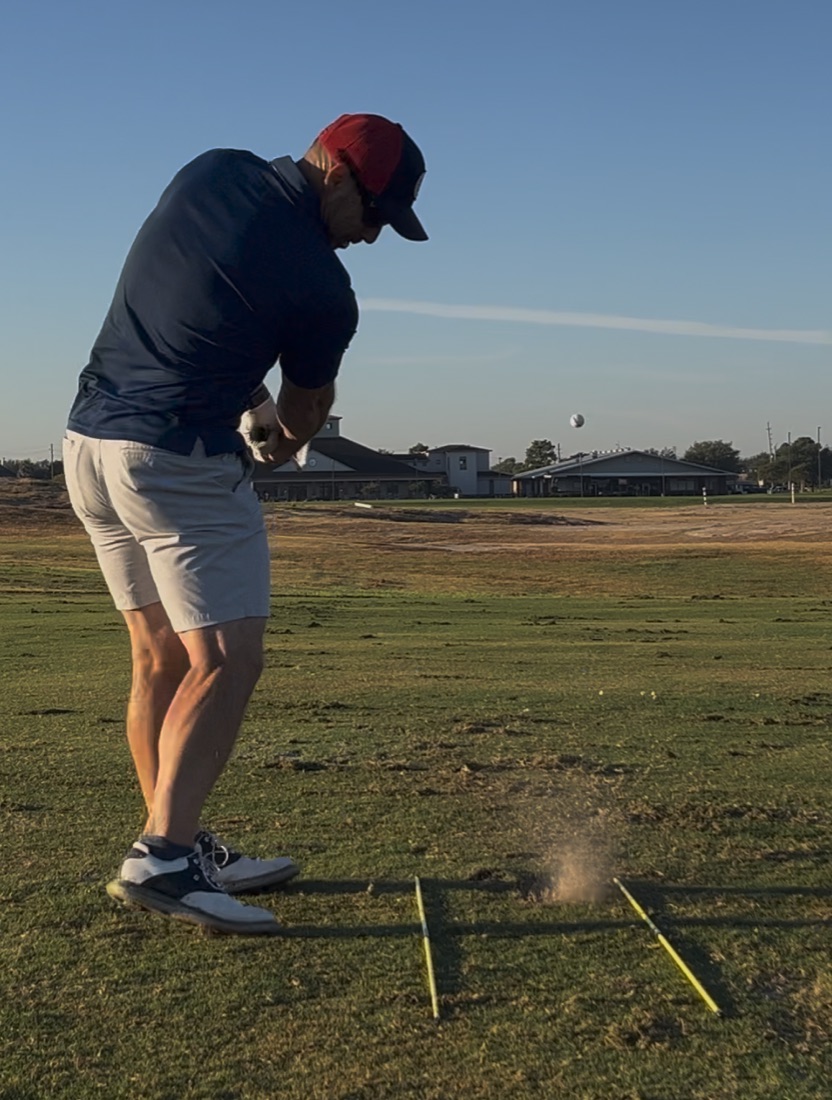
Two, take two alignment sticks or golf clubs and put one between your legs pointing at the ball, but 5-6 or so inches behind the ball. Place another alignment stick on the other side of the ball about the same distance, or more. Again, swing away and note where the divot starts and the deepest part of the divot.
Center strikes with a descending blow feel Heavenly.
Fat and thin shots, not so much. (No worries, you just need a little work)
Before you fix anything, you need to know what’s actually broken.
What Launch Monitor Numbers Reveal Strike Quality?
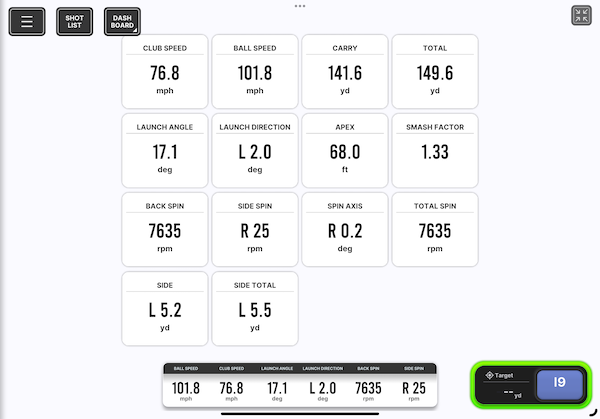
If you have access to a launch monitor, three numbers matter:
Smash Factor (ball speed ÷ club speed): Irons should be 1.30-1.40. Below that means you’re missing the sweet spot or catching it thin/fat.
Spin Rate: Too high usually means you’re hitting high on the face or adding loft at impact. Too low (or wildly inconsistent) means thin contact or a flipped release.
Attack Angle: Should be slightly negative for irons. If it’s positive or zero, you’re either catching it on the upswing or your low point is way behind the ball.
Track these over 20-30 shots. The average matters less than the consistency—tight groupings mean repeatable contact.
How Should I Set Up For Ball-First Contact?

Setup determines 70% of strike quality. (Great swings with poor setup aren’t very useful)
Weight forward: 55-60% on your lead foot at address. This shifts your swing’s center forward so the club naturally bottoms out past the ball.
Posture and alignment: Hinge forward from your hips (not your waist). Your shoulders should sit over the balls of your feet. Your hip joints should align vertically over your ankles—this keeps you balanced and athletic. From here, bump your lead hip slightly toward the target so it sits over your lead ankle. This stabilizes your low point on the target side of the ball. You’ll swing around that forward hip position.
Ball position: Center of your stance for mid-irons. The farther back you go, the more likely you’ll catch it clean (but you’ll deloft the club). Start conservative—move it forward only when you’re consistently hitting ball-first.
Forward shaft lean: Hands slightly ahead of the ball at address (5-10°). This sets up the impact position you want—lead wrist flat or bowed, hands leading the clubhead through contact.
What Drills Build Reliable Ball-First Contact?
These drills come from actual practice plans I’ve used (and my collaboration with instructor Chris Westerdahl). They work because they give you immediate feedback.
Drill 1: Towel Drill (Fat Shot Fix)

Fold a towel thick enough to notice if you clip it. Place it about a grip’s length behind the ball to start. Move closer as you get more comfortable with drill.
Your job: hit the ball without touching the towel.
Start with half swings. If you’re catching the towel, you’re dropping the club too early or hanging back.
Move the towel closer as you improve—when you can place it grip-length behind the ball and miss it consistently, your low point control is dialed.
Reps: 3 sets of 8-12 shots, slow tempo (3-1 rhythm: “back-set-through”)
No towel? Use a second golf ball or stick an alignment rod in the ground at an angle.
[Source: HackMotion – Best Drills for Solid Iron Contact]
Drill 2: Brush The Grass (Tempo + Contact)
No ball for this one. Take your pitching wedge and make smooth back-and-forth swings brushing the grass at the same spot every time.
Start with hip-high swings. Gradually build to full swings, keeping the rhythm identical.
The key: as your swing gets longer, the brush point should move slightly forward of center. That’s your low point shifting forward like it should in a real swing.
Reps: 5 minutes daily, 20-30 swings focusing only on tempo and consistent ground contact
This is the best drill for feel. You’ll know immediately when you’re catching it clean.
Drill 3: Hide The Stick (Impact Position)

This one’s from Paul Waring. Clamp an alignment stick to your club with your hands so the upper part of the stick extends past your grip toward your body.
Make practice swings focusing on impact position. If you’re flicking at the ball (early release), the stick will hit your side. If you’re driving forward too much without proper release, the stick gets too far from your body.
Done right, the stick stays hidden behind your arm, shoulder, and club through impact—everything’s aligned, hands ahead of the ball, proper shaft lean.
Reps: 10-15 slow swings per session, then hit 5-8 balls maintaining that feeling
This drill gives you instant feedback on whether you’re delivering the club correctly or losing your angles.
Drill 4: Lead Leg Loaded Drill (Weight Shift Fix)

Pull your trail foot back so 70-80% of your weight is on your lead leg. Hit shots from this position.
You’ll immediately feel if you’re swaying back or hanging on your trail side—the drill won’t let you. Keep your chest moving toward the target through impact. Start with short irons and work up to mid-irons.
Reps: 3 sets of 6-8 shots
Gradually widen your stance as the feeling becomes natural, but keep that forward weight bias.
[Source: HackMotion – Best Drills for Solid Iron Contact]
Drill 5: 2×4 Takeaway Drill (Connection)
This one’s from our practice plan. Place a 12-inch 2×4 (or a weighted alignment stick) one clubhead length behind your ball at address.
On your takeaway, push that 2×4 straight back using your arms and chest together—not your hands. The weight of the 2×4 forces you to use your bigger muscles and keeps your takeaway connected.
Reps: 10-15 takeaways (no ball), then hit 5-8 shots applying that same feeling
This syncs up your arms and body, which directly improves low point control at impact.
What Drills Improve Low Point Control And Divot Pattern?
If your divots are inconsistent—sometimes behind the ball, sometimes thin with no divot—these drills lock in your low point.
Line Drill

Scratch a line in the grass (or use foot spray). Place the ball on the line. Your goal: every divot should start on the target side of that line.
Hit 10 shots with a 7-iron. Count how many divots start past the line. Score yourself—7+ is good, 9+ is tour-level.
As you improve, move to a 5-iron or 4-iron. Longer clubs make low point control harder because the arc is flatter.
[Source: Danny Maude – Strike Your Irons Perfect]
Two Tee Drill

Place a tee behind the ball and one in front of it, about 2 inches apart. Put the ball on the front tee.
Your job: hit the front tee and leave the rear tee standing. If you hit the rear tee, you’re contacting ground-first.
Reps: 10 swings per session, checking tees after each shot
This is binary feedback—you either nailed it or you didn’t. No guessing.
[Source: Paul Waring via Golf Monthly]
What Progressive Practice Plan Should I Follow Weekly?
Here’s the program. 50 minutes per day, 5 days a week, for 6-8 weeks.
Week 1-2: Assessment and Foundation
Daily Session (50 min):
- Contact Combine Assessment: 10 min (establish baseline—see below)
- Brush the Grass: 5 min
- Tempo Drill (3:1 rhythm): 5 min
- Sway Drill (alignment stick behind tailbone): 20 min
- Contact Combine Re-Test: 10 min
Log everything. How many ball-first contacts out of 10? How many center-face strikes?
Week 3-4: Build Consistency
Daily Session (50 min):
- Contact Combine Assessment: 10 min
- Brush the Grass: 5 min
- Tempo Drill: 5 min
- 2×4 Takeaway Drill: 20 min
- Contact Combine Re-Test: 10 min
You should see improvement in your scores by Week 3. If not, spend more time on whichever drill addresses your miss—towel for fat shots, lead leg loaded for hanging back.
Week 5-6: Add Variability
Daily Session (50 min):
- Contact Combine Assessment: 10 min
- Brush the Grass: 5 min
- Random club/target practice: 25 min (mix drills, don’t hit same club twice)
- Contact Combine Re-Test: 10 min
Now you’re training adaptability. Change clubs, change targets, simulate on-course scenarios.
Week 7-8: Sharpen and Taper
Reduce volume, increase quality. 3 sessions per week, 40-45 minutes. Focus on drills that fixed your specific fault. Run final Contact Combine assessment to compare against Week 1.
Expected improvement: 20-30% increase in ball-first contacts, 15-25% increase in center-face strikes.
Contact Combine Assessment (Track Your Progress)
This is how you measure if your hard work is actually helping.
Assessment 1: Ball-First Contact
Spray a line on the grass. Hit 10 balls with a 7-iron. Count how many divots start on the target side of the line.
Assessment 2: Centered Strike
Spray your clubface. Hit 10 balls. Count how many marks are in the center third of the face.
Run this before and after every practice session. Log it in a notebook or your phone.
Week 1 baseline for most mid-handicappers: 4-6 ball-first, 3-5 centered.
Week 6 target: 8-9 ball-first, 6-8 centered.
If you’re not improving, check your setup. Nine times out of ten, weight is still too far back or ball position is too far forward.
[Image: Example tracking sheet showing weekly progression from 40% ball-first to 80% over 6 weeks]
Iron Ball Striking FAQs
What club should I use for practice?
Start with a 7-iron. It’s right in the middle—forgiving enough to see results quickly but honest enough to expose faults.
Once you’re consistent with the 7, test a 5-iron (less margin for error) and a 9-iron (different ball position and swing length).
How do turf conditions affect low point control?
Softer turf hides mistakes—the club bounces and you might get away with early contact. Firm turf punishes everything.
How should I warm up before ball-first drills?
You should always warm up before you practice or play. This becomes vitally important as you age.
3-5 minutes of brush-the-grass swings, then 5-6 half-speed shots focusing only on strike location. Don’t worry about distance or target until you’ve grooved the contact pattern.
How do I transfer range practice to real rounds?
Run your pre-shot routine for every range shot—visualize the target, take one practice swing, commit. Treat range balls like they matter.
And once per week, play 9 holes immediately after a drill session while the feel is fresh.
Ready-To-Use Practice Templates
I’ve included a detailed practice schedule in the program outline above, but here’s what you actually need at the range:
Printable drill checklist:
- Towel Drill: 3 x 10 reps, 3-1 tempo
- Brush the Grass: 5 min, focus on forward low point
- Line Drill: 10 shots, count ball-first contacts
- 2×4 Takeaway: 10 reps without ball, 8 shots applying feel
Weekly tracking sheet columns:
- Date
- Club used
- Ball-first contacts (out of 10)
- Center-face strikes (out of 10)
- Notes (what felt good, what needs work)
You can download a pre-formatted tracking sheet from our Iron Game Secrets resource.
Final Thoughts on The Best Drills for Solid Iron Contact
Most golfers practice drills for a week, don’t see instant results, and bail. That’s not how this works.
You’ll likely see some improvement pretty fast, but it takes hundreds and hundreds of proper reps to make the changes “yours.” This is how it works for most of us.
Solid iron contact comes from controlling two things: where your club bottoms out, and whether you’re catching the sweet spot. The drills in this article systematically fix both—but only if you actually run the program and track your numbers.
Start with the Contact Combine assessment.
Run it before your next range session and get your baseline. Then pick two drills that address your biggest miss (fat shots = towel drill, thin contact = brush the grass, inconsistent low point = line drill) and commit to 50 minutes a day for two weeks.
Thanks for checking out our guide to the best drills for solid iron contact. Let us know how they work for you.
Sources
Golfer Geeks / Chris Westerdahl Golf – “Iron Game Secrets Cheat Sheet”
(Contact Combine Assessment protocol, 2×4 Takeaway Drill, practice schedule framework, tracking methodology, brush the grass drill)
HackMotion – “6 Best Golf Drills for Achieving Solid Iron Contact“
(Towel Drill, Lead Leg Loaded Drill, Ruler Drill methodology, wrist mechanics concepts)
Golf Monthly – Paul Waring: “4 Tour Pro Drills To Help You Flush Your Irons“
(Alignment stick gate drill, Two Tee Drill, angle of attack concepts, shaft plane drill)
Danny Maude – “You Will Strike Your Irons Perfect If You Follow This Process“
(Low point control concepts, circle swing visualization, line drill assessment, setup fundamentals)